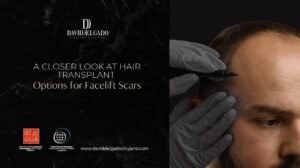
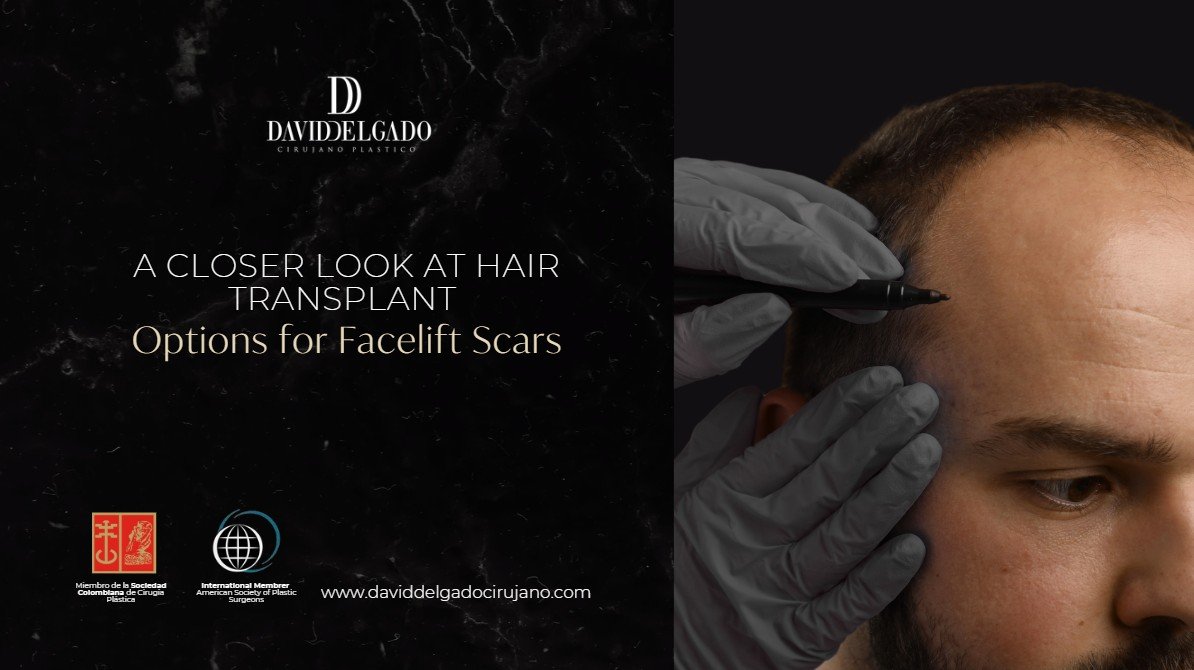
A facelift can create a more refreshed and youthful appearance, but when visible facelift scars remain around the temples, sideburns, hairline, or ears, they can draw attention in ways patients did not expect. In our experience, hair transplant for facelift scars can be a valuable option in carefully selected cases, especially when the scar becomes more noticeable because of altered hairline design, reduced density, or uneven healing. While many facelift scars improve beautifully over time, others remain visible enough to affect how naturally the result blends with the surrounding hair.
That is where a facelift scar hair transplant may help. Rather than “erasing” the scar, the goal is to soften its appearance by restoring strategic coverage and improving the visual transition between the scar and the surrounding hair-bearing areas. This can be particularly helpful in patients dealing with hairline scars or thinning around the sideburns after facial surgery. As with any scar-related case, however, the key is proper evaluation, because not every scar behaves the same way. Later in this article, we will explain what makes a patient a good candidate and why a specialized assessment in Medellín matters when planning this type of treatment.
When Hairline Refinement May Be Considered After a Facelift
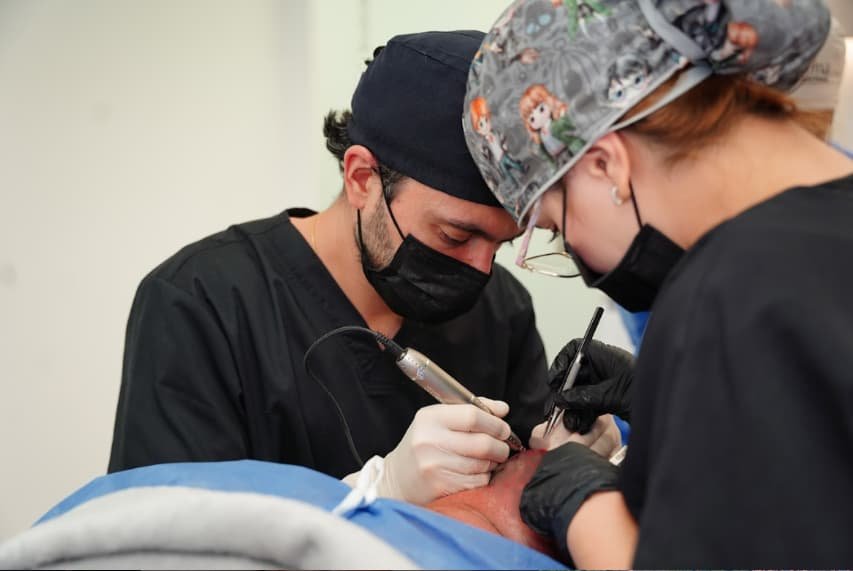
A facelift is designed to create smoother, younger-looking contours. However, when healing does not blend as seamlessly as expected, the scar can start to attract attention instead of disappearing into the surrounding anatomy. In our experience, this usually happens gradually: once swelling resolves, tissues settle, and the final hairline becomes easier to assess, some patients notice that the scar is more visible than they initially thought.
Common areas where facelift scars may show
Even when incisions are placed strategically, facelift scars are often located in areas where the eye naturally notices transitions between skin, hair, and facial contour. Because of that, a scar does not need to be severe to become visually distracting.
The most common areas include:
- The temple area
- The sideburn area
- In front of the ears
- Behind the ears
- Along the hairline
These locations matter because they are not visually neutral. They help define facial framing, hair symmetry, and side profile balance. Therefore, when a scar sits in one of these zones, even a subtle irregularity may be easier to detect, especially with the hair pulled back, styled away from the face, or worn shorter around the temples and sideburns.
Why these areas matter aesthetically
The temple and sideburn regions, in particular, play an important role in how natural a facelift result appears. If a scar interrupts that transition, shifts the hair-bearing border, or leaves a small gap where hair used to grow, the result may look less harmonious even when the surgery itself was otherwise successful.
How hairline changes can make a scar more noticeable
In many cases, the issue is not only the scar itself, but everything happening around it. A scar may become more noticeable when the surrounding hair no longer softens the area the way it once did. This is one of the main reasons patients later start researching options such as hair transplants for hairline scars or hair transplant for sideburn scars.
Several factors can make a scar stand out more over time:
- Reduced hair density around the incision
- Hairline displacement or an unnatural shift in contour
- Sideburn loss or thinning in front of the ear
- Color contrast between the scar and surrounding skin
- Texture differences, especially if the scar looks flatter, wider, firmer, or shinier
- Scar tension, which can make the line appear broader or more defined
In other words, visibility is often the result of contrast. When normal hair patterns are disrupted, the eye is drawn directly to the incision line. That is why some scars seem more obvious months later: not because they worsen, but because the surrounding area no longer conceals them naturally.
A scar can be small and still look obvious
This is an important point. A facelift scar does not have to be thick or hypertrophic to become a cosmetic concern. If it changes the shape of the hairline, breaks the continuity of the sideburn, or creates an empty-looking transition zone, it may look more noticeable than a larger scar placed in a less visible area.
Why some patients look for facelift scar repair after surgery
Once the initial healing phase is over, patients usually become much more aware of details. At that stage, they are no longer focused on swelling or recovery—they are evaluating the final aesthetic integration of the result. That is often when interest in facelift scar repair begins.
Patients typically seek further evaluation when they notice one or more of the following:
- The scar is still visible with normal daily hairstyles
- The hairline looks less natural than before surgery
- The sideburn appears thinner, shortened, or asymmetrical
- Makeup helps only partially
- The scar has healed, but the area still lacks visual softness
In selected cases, this is also when a hair transplant after facelift becomes part of the conversation. Not because the goal is to remove the scar completely, but because restoring hair in a precise and strategic way may help camouflage the transition and make the area look more natural again.
When repair is not about the scar alone
Sometimes the real issue is not the quality of the scar—it is the loss of framing around it. That distinction matters. A scar can be well healed from a medical standpoint and remain aesthetically visible because the surrounding hair no longer provides enough coverage. In those situations, treatment planning must go beyond the scar itself and assess whether hair restoration could improve the overall appearance.
That is exactly why proper evaluation matters. Before considering any solution, we need to understand whether the concern is related to scar texture, scar position, altered hairline design, or reduced density around the incision. Only then can we determine whether camouflage may benefit the patient and whether that case should be approached as part of a broader facelift scar repair strategy.
You may be interested Understanding Hair Loss: Causes, Symptoms & Proven Solutions
Can a hair transplant help hide facelift scars?
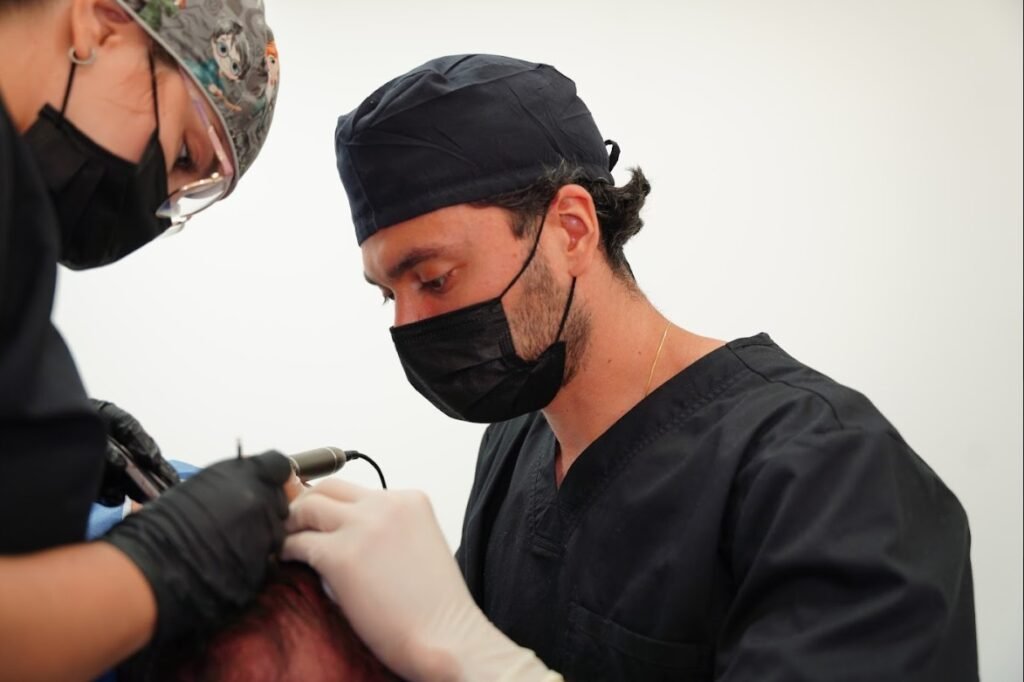
The short answer is yes—in selected cases, a hair transplant for facelift scars can help make a scar less noticeable by restoring hair in the incision or immediately around it. That said, the goal is not to erase the scar itself. Instead, the purpose of a facelift scar hair transplant is to improve visual coverage, soften the transition between scar tissue and surrounding hair-bearing skin, and make the area look more natural in everyday life.
This is particularly relevant when the scar affects parts of the face and hairline that are difficult to hide. In our experience, patients are often bothered when the scar changes the facial frame rather than when the scar line itself is severe. For that reason, a well-planned scar camouflage hair transplant may be especially helpful in cases involving temporal irregularities, thinning in the sideburn area, or scars that remain visible in front of the ear.
How a facelift scar hair transplant works
A facelift scar hair transplant works by placing follicular units into or around the scarred area in a way that helps the region blend more naturally with the surrounding hair. However, this is not simply a matter of placing grafts over a line. Scar tissue behaves differently from normal skin, so the planning must be more precise from the start.
Before considering transplantation, we typically need to assess:
- The maturity of the scar
- The vascularity of the tissue
- The degree of hair loss or thinning around the incision
- The quality and density of the donor area
- The design needed to create a more natural transition
In practical terms, the procedure may help improve:
- Temporal hairline scars
- Sideburn thinning after facelift
- Preauricular scar visibility
- Subtle gaps or irregularities along the hairline
What a hair transplant can improve and what cannot remove
This is one of the most important distinctions to make. A hair transplant can improve the way a facelift scar looks, but it does not remove the scar itself. In other words, it is a camouflage strategy—not a scar erasure procedure.
What a hair transplant may improve:
- Visual softness around the scar
- Continuity of the hairline
- Sideburn definition
- Coverage in areas where the scar interrupts natural hair growth
- The overall harmony of the result
What a hair transplant cannot guarantee:
- Complete disappearance of the scar
- Identical density to untouched skin
- The same graft behavior seen in completely healthy scalp tissue
- Universal success in every scar type
Why outcomes vary from case to case
The result depends on several variables, including scar maturity, blood supply within the tissue, donor hair quality, and how well the design fits the patient’s anatomy. A flat, mature scar with acceptable vascularity is very different from a wide, tense, or poorly perfused scar. That is why not every patient seeking hair transplant for facelift scars will have the same treatment plan—or the same expected outcome.
When Hair Transplant for Facial Scars May Be Considered
In general, hair transplant for facial scars may be considered when the scar has already stabilized, the patient remains bothered by visible disruption in the hair-bearing area, and the goal is realistic improvement rather than perfection. In many cases, patients seek treatment because they feel the scar keeps drawing attention to the temple, the sideburn, or the area in front of the ear, even long after the initial facelift recovery is over.
A specialist may begin considering this option when:
- The scar is mature and no longer actively changing
- Hair loss around the incision makes the scar more obvious
- The sideburn or hairline has lost symmetry
- The donor area can provide enough grafts for a natural-looking plan
- The patient understands that camouflage is the goal
A scar camouflage hair transplant is not about overcorrecting the area. It is about restoring balance. In the right patient, even modest graft placement can make a meaningful difference by softening the visual break created by the scar and helping the area blend more naturally with the rest of the hairline.
You may be interested Colombia Hair Transplant: Cost Breakdown
Who may be a good candidate for hair transplant after facelift?
Not every visible scar needs hair transplantation, and not every patient with a facelift scar will benefit from it in the same way. Still, there are situations in which hair transplant after facelift may be a very reasonable option, especially when the main issue is not just the scar line itself, but the loss of hair coverage around it.
In our experience, the best candidates are usually those who have completed the initial healing phase, had a stable scar, and remained concerned about how the area looks in daily life. This may involve the temples, the sideburns, the preauricular area, or parts of the hairline where even a small interruption can affect facial framing.
Signs a patient may benefit from scar camouflage hair transplant
A patient may be a good candidate for scar camouflage hair transplant when the scar has healed but still looks visible because the surrounding hair no longer provides enough coverage. This is often the case when the problem is aesthetic integration rather than active scar healing.
Common signs include:
- A mature, stable scar
- Noticeable hair loss around the incision
- Visible asymmetry in the temple, sideburn, or hairline
- Enough donor hair to support treatment
- Realistic expectations about what the procedure can and cannot do
What makes a candidate stronger?
Some of the most favorable cases are those in which the scar is relatively flat, the surrounding anatomy is well preserved, and the donor area offers hair that matches the texture and caliber needed for natural blending. In those situations, hair transplant for scars may offer a meaningful cosmetic improvement without making the treatment look obvious.
When it may be better to wait before treating a facelift scar
Timing matters. Even when a scar is bothersome, it may still be too early to treat it. In general, if the tissue is still changing, the treatment plan may be premature.
It may be better to wait when:
- The scar is still recent
- The area remains inflamed, red, or firm
- The tissues are still settling after surgery
- The final shape of the hairline is not yet clear
- The scar does not yet show enough stability for graft placement
Why waiting can improve decision-making
Scar tissue evolves over time. A scar that looks highly visible in the early months may soften significantly as healing continues. On the other hand, a scar that remains noticeable after appropriate healing may become a better candidate for facelift scar repair once the tissue is more stable and predictable. Waiting, therefore, is not necessarily delaying treatment, it is often part of better planning.
Why scar tissue needs individual evaluation
This is where many patients need honest guidance. Hair transplant after facelift is not evaluated the same way as a routine scalp hair transplant, because scar tissues do not behave like normal scalp skin. Its blood supply may be different, its texture may be less predictable, and its capacity to support graft survival can vary from one patient to another.
What needs to be assessed carefully?
A proper evaluation should look at:
- Scar texture and thickness
- Tissue mobility and softness
- Vascular quality
- Contrast between the scar and surrounding skin
- Donor hair availability
- The aesthetic role of the area being treated
For example, a temple scar and a sideburn defect are not planned the same way. Similarly, a patient with a well-defined donor area and realistic expectations will not be approached in the same manner as someone with minimal donor reserves or a scar that is still evolving.
That is why we never view hair transplant for scars as a one-size-fits-all solution. When treatment is appropriate, it should be based on an individualized assessment of the scar, the surrounding hair, and the overall facial balance. Only then can we determine whether a patient is truly a good candidate and whether transplantation may play a meaningful role within a broader facelift scar repair strategy.
You may be interested Looking for a Hair Transplant Clinic in Medellín? Meet Dharma Hair
What to expect from hair transplant for facelift scar repair
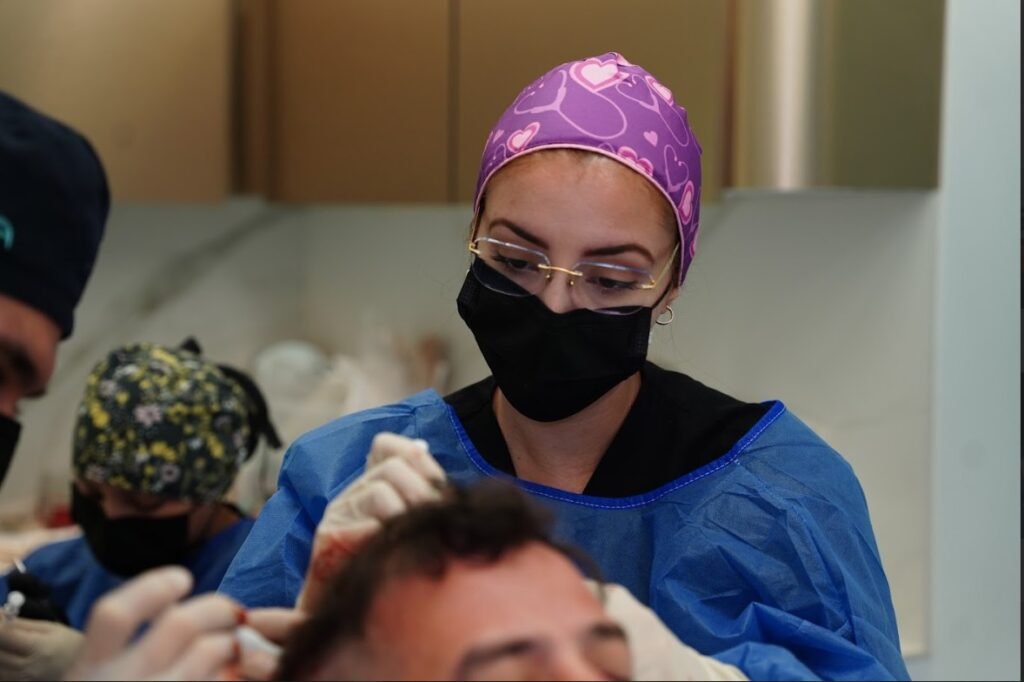
When patients begin exploring hair transplant for facelift scar repair, one of the first things we explain is that this is not planned exactly like a standard hair restoration case. Scar tissue changes the way we evaluate the area, the way we distribute grafts, and the way we set expectations. In other words, success is not only about placing hair follicles—it is about placing them with precision, restraint, and a clear aesthetic strategy.
That is why this type of treatment should always be approached with realism. A well-executed scar camouflage hair transplant can often make the area look softer, more balanced, and less visually disruptive. However, the improvement tends to be progressive, and the final goal is usually better camouflage and a more natural transition, not the complete disappearance of the scar.
Planning hair graft placement in scar tissue
Planning is especially important when we are working with scar tissue. Unlike healthy scalp skin, a scar may have different vascularity, a different surface texture, and a different capacity to support graft survival. Because of that, we do not simply ask how many grafts can be placed, we ask where they should go, at what angle, with what spacing, and with what density.
A careful plan usually considers:
- The direction of existing hair
- The possible density the tissue can realistically support
- The way the grafts will integrate with the hairline or sideburn
- The width, texture, and maturity of the scar
- The need to maintain a natural-looking transition rather than an artificially dense patch
Why placement matters more than volume
In cases such as hair transplant for hairline scars, more is not always better. If grafts are placed too densely, too uniformly, or in the wrong direction, the result can look unnatural—even if the scar becomes less visible. For that reason, the design phase is just as important as the implantation phase. Our goal is to recreate continuity, not simply add hair.
Areas that often require the most design sensitivity
Some of the most detail-sensitive areas include:
- The temporal hairline
- The sideburn border
- The preauricular region
- Small transition zones where the scar interrupts facial framing
These are areas where even subtle changes can make a major visual difference, which is why hair transplant for scars in these zones requires a more refined and individualized approach.
Recovery and hair growth timeline after scar camouflage
Another important point to understand is that the improvement is not immediate. After a scar camouflage hair transplant, patients usually go through a recovery process that unfolds in stages. The area treated may look different before it looks better, and that is completely normal.
In general, patients can expect:
- An initial healing period in which the area may show mild redness, sensitivity, or small crusts
- An early phase in which the grafts settle into place
- A gradual growth cycle rather than instant coverage
- Progressive visual improvement over time, not overnight
Why patience matters after treatment
Transplanted hair follows a biological cycle. That means the final cosmetic change happens gradually as the follicles establish themselves and new growth becomes more visible. For that reason, we always emphasize that patients should not judge the outcome too early. The purpose of treatment is to improve how the scar blends with the surrounding hair over time, and that process takes patience.
Not every scar evolves the same way
This is especially true in scar cases. A scar with good tissue quality and favorable vascularity may respond differently than one that is wider, firmer, or more compromised. As a result, the timeline and the degree of improvement can vary from one patient to another. That is one of the reasons why hair transplant for facelift scar repair must be planned conservatively and followed with realistic expectations from the beginning.
Sometimes a conservative plan is the right plan
In some patients, the safest and most aesthetically sound option is to take a conservative approach. That may mean placing fewer grafts than expected, prioritizing natural blending over density, or even considering more than one session if the tissue characteristics suggest that gradual improvement is the better path. In cases like these, thoughtful planning is not a limit, it is part of what makes the result look believable.
Ultimately, the success of a hair transplant for facelift scar repair depends on matching the plan to the scar, the surrounding anatomy, and the patient’s expectations. When those elements align, a scar camouflage hair transplant can make a meaningful difference by helping the treated area look less interrupted, less obvious, and more naturally integrated into the face and hairline.
Why choose Be Dharma Hair for hair transplant for facelift scars in Medellín
For patients looking for hair transplant for facelift scars in Medellín, Be Dharma Hair offers a more specialized path within Clínica Be Dharma. Created as the clinic’s dedicated hair restoration line, it focuses on hair restoration in Medellin through personalized evaluation, detailed planning, and a natural-looking approach tailored to each case. This matters in scar-related treatments, where success depends not only on placing grafts, but on understanding scar tissue, assessing the surrounding hairline or sideburn area, and designing coverage that feels balanced and believable. Located in Torre Médica Oviedo, Be Dharma Hair provides a reliable clinical setting for patients who want careful guidance and a solution that is planned with both precision and aesthetics in mind.
In our view, cases such as hair transplant after facelift require exactly that kind of individualized attention. Be Dharma Hair stands out by combining advanced technology, thoughtful treatment planning, and a strong focus on results that look soft, natural, and long-lasting. For anyone considering a hair transplant in Medellin, especially in detail-sensitive cases where facial harmony matters, Be Dharma Hair represents a strong option for specialized care inside a trusted clinical environment.
Frequently Asked Questions About Hair Transplant for Facelift Scars
Can a hair transplant completely remove a facelift scar?
No. A hair transplant for facelift scars does not remove the scar itself. Instead, it helps camouflage it by placing hair follicles in or around the scar so the area blends more naturally with the surrounding hair. In the right patient, this can make the scar look much less noticeable, but the goal is improvement in coverage and visual integration, not scar erasure.
How long should I wait after a facelift before considering a hair transplant?
In most cases, it is best to wait until the scar has matured and the tissues have stabilized before considering treatment. That is important because a scar changes over time, and early evaluation may not reflect its final appearance. A specialist usually needs to confirm that the area is fully healed and suitable for graft placement before planning a hair transplant after facelift.
Can transplanted hair grow normally in scar tissue?
It can, but scar tissue does not behave exactly like normal scalp skin. Growth depends on factors such as blood supply, scar quality, tissue thickness, and the way the grafts are placed. Some scars support graft survival better than others, which is why careful evaluation and planning are essential when performing a hair transplant for scars.
Who is a good candidate for hair transplant for facelift scars?
A good candidate is usually someone with a mature, stable facelift scar, visible loss of hair around the incision, and enough donor hair to support treatment. Patients who are bothered by disruption in the hairline, temples, or sideburn area may benefit the most. Just as importantly, the ideal candidate understands that the objective is camouflage and natural improvement, not absolute perfection.
What areas can be improved with a facelift scar hair transplant?
A facelift scar hair transplant may help improve scars located along the temporal hairline, sideburn area, preauricular region, and other hair-bearing zones affected by facelift incisions. It can be especially helpful when the scar creates a break in the natural frame of the face or when thinning around the area makes the scar more visible.
Is hair transplant for facial scars the same as a regular hair transplant?
Not exactly. A hair transplant for facial scars usually requires more careful planning than a routine hair transplant because the tissue characteristics are different. Scar tissue may have lower vascularity, altered texture, or limited capacity for dense graft placement. That means the treatment often needs a more customized and sometimes more conservative approach.
Will the results look natural?
They can look very natural when the case is well selected and properly planned. Natural-looking results depend on factors such as hair direction, graft angle, donor hair quality, and how well the transplanted follicles integrate with the surrounding hairline or sideburn. In scar cases, precision matters just as much as the grafts themselves.
How many grafts are needed for hair transplants for facelift scars?
There is no single number that applies to every case. The number of grafts depends on the size of the scar, the amount of surrounding hair loss, the density that the tissue can safely support, and the overall design goal. Some patients need only limited grafting for strategic camouflage, while others may need a broader plan to improve the transition around the scar.
Can more than one session be necessary?
Yes, in some cases it can. When scar tissue is less predictable or when a conservative first session is the safest option, a second session may sometimes be considered later. This does not necessarily mean something went wrong; rather, it can be part of a gradual treatment strategy designed to achieve more natural and reliable results over time.
Where can I get evaluated for hair transplant for facelift scars in Medellín?
If you are looking for hair transplant for facelift scars in Medellín, Be Dharma Hair is a specialized option within Clínica Be Dharma. As the clinic’s hair restoration line, it offers personalized evaluation, detailed planning, and a natural-looking approach for patients seeking hair restoration in Medellin, including cases where facelift scars affect the hairline, sideburns, or other visible facial transition areas.