
Author
Dr. David Delgado, MD
Maxillofacial and plastic surgeon trained at Universidad Industrial de Santander and Universidad de Antioquia. Member of the American Society of Plastic Surgeons (ASPS), with over fifteen years of clinical practice in Medellín, Colombia.
- ASPS — Member
- SCCP
- UdeA Postgraduate Professor
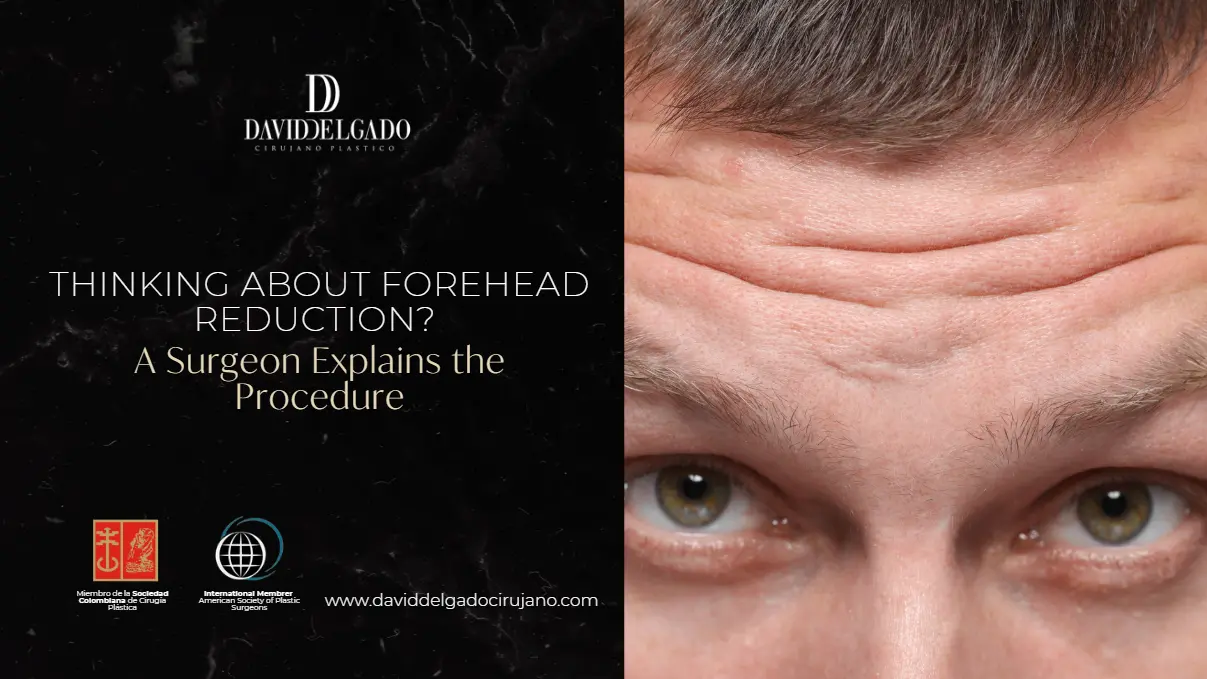
Have you ever felt that your forehead looks too long or that your hairline sits higher than you would like, but you are not sure what procedure could change it? In my practice, this is one of the first distinctions I clarify with patients. Forehead surgery reduction usually refers to forehead reduction surgery, also known as forehead lowering surgery, hairline lowering surgery, or hairline advancement surgery. The goal is to reduce the visible height of the forehead by surgically advancing the hairline, creating a different balance between the hairline, eyebrows, and the rest of the face.
This is not the same as a forehead lift or brow lift. A brow lift is designed primarily to reposition the eyebrows and forehead tissues, while forehead reduction surgery changes the position of the hairline itself. Before recommending surgery, I look carefully at the patient’s hairline pattern, scalp mobility, hair density, facial proportions, and the stability of the hairline over time. These details matter because of the amount of advancement that can be achieved safely—and how natural the final hairline can look—depends on each patient’s individual anatomy.

Considering Forehead Surgery Reduction in Colombia?
If you already understand what forehead reduction surgery involves and you are seriously considering the procedure, the next step is not simply choosing a date. It is confirming whether your anatomy, hairline, scalp mobility, and expectations make you a suitable candidate. In my practice in Medellín, Colombia, I evaluate each case individually before defining how much the hairline could be advanced and what surgical plan would be appropriate.
Already researching forehead reduction surgery? Your next step is a surgical evaluation
During the evaluation, I focus on the factors that directly influence the safety and design of hairline advancement surgery:
- Current hairline shape and height
- Scalp mobility and tissue characteristics
- Hair density and signs of progressive hair loss
- Facial proportions and eyebrow position
- Previous scalp or facial procedures
- The patient’s goals and expectations
The objective is not simply to make the forehead “smaller.” It is to determine whether forehead lowering surgery can create a proportion that looks natural for your face while respecting the limitations of your anatomy.
Planning forehead surgery in Colombia as an international patient
If you live outside Colombia, part of the evaluation and planning process can begin before you travel to Medellín. This allows mychange ande to review your case, understand what you would like to change, and determine what additional information or medical evaluation may be required before surgery.
Before traveling, we can start by clarifying:
| Planning point | Why it matters |
|---|---|
| Your main concern | Helps define whether forehead reduction is actually the right procedure. |
| Hairline and scalp anatomy | Influences how the surgery may be planned. |
| Medical history | Identifies factors that may affect surgical candidacy. |
| Travel timeline | Helps coordinate consultation, surgery, and early recovery in Medellín. |
Request a personalized evaluation with Dr. David Delgado
If you are considering forehead surgery reduction in Colombia, you can request an individual evaluation to determine whether this procedure is appropriate for your anatomy and goals.

Is a High Forehead Really the Problem? Understanding What Forehead Reduction Can Change
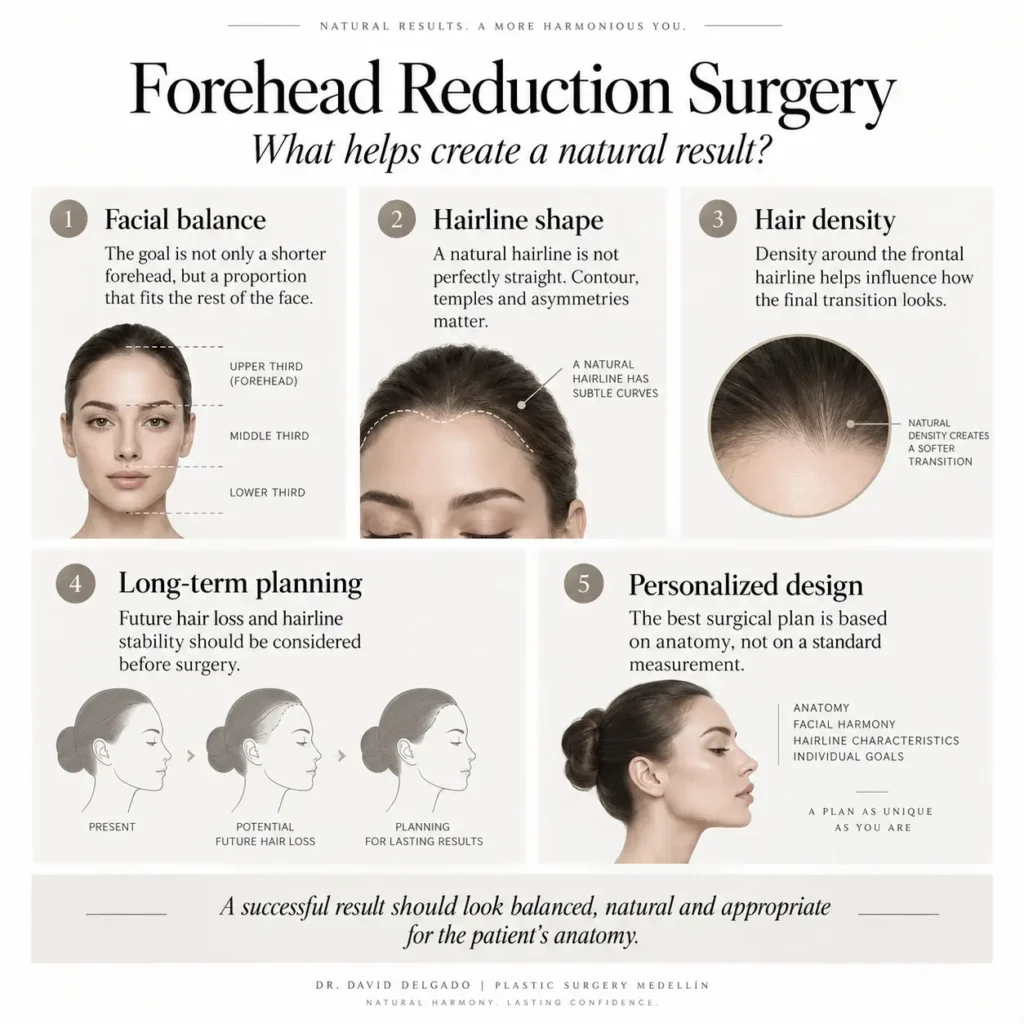
Before I recommend forehead reduction, I first determine what is creating the concern. A forehead can appear long because the hairline sits high, because the eyebrows sit low, because of the relationship between the upper, middle, and lower thirds of the face—or because several of these factors are present at the same time.
That distinction matters. If the hairline is the real issue, lowering it may change the proportions of the upper face. If the concern comes primarily from brow position, however, a completely different procedure may be more appropriate.
When a high hairline—not the eyebrows—is what changes your facial proportions
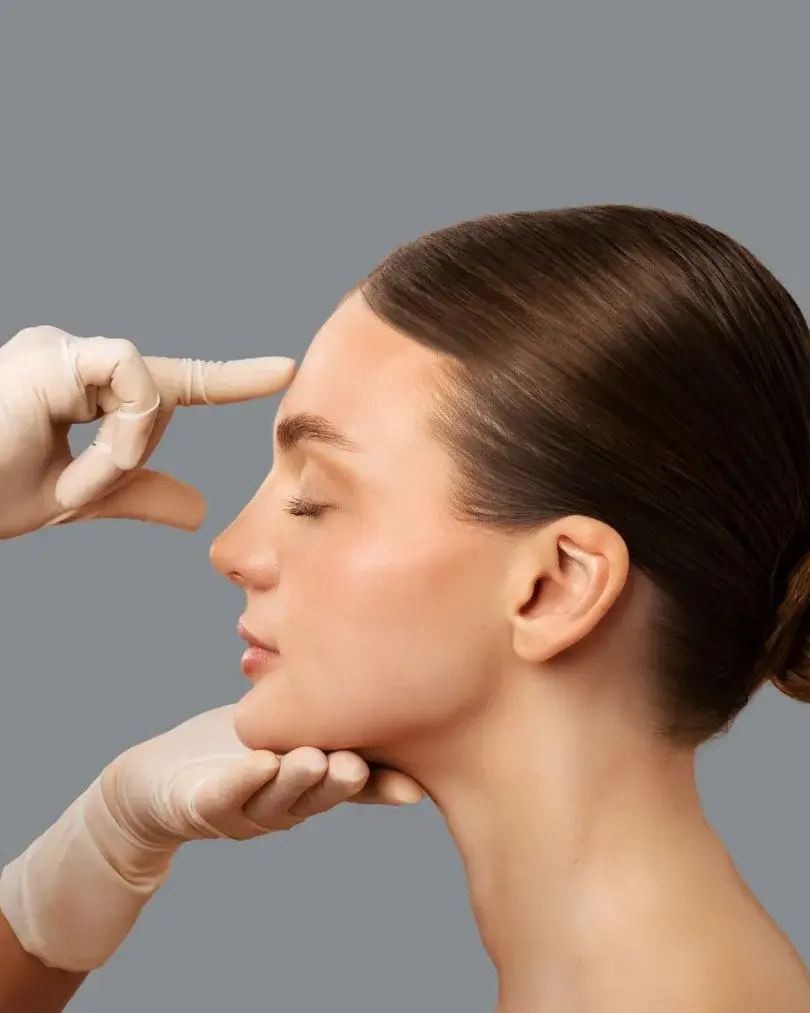
What I evaluate is the relationship between the frontal hairline, eyebrows, temples, and the rest of the face.
When the frontal hairline naturally sits higher, the distance between the eyebrows and the beginning of the scalp becomes more noticeable. This is the type of concern patients often describe when researching high forehead surgery or forehead lowering surgery.
In these cases, the purpose of surgery is not to alter the eyebrows. The objective is to advance the hair-bearing scalp forward so that the visible height of the forehead is reduced.
One detail I pay particular attention to is whether the hairline has always been high or has gradually moved backward. This distinction is important because the literature identifies a stable frontal hairline and adequate scalp mobility as important characteristics when considering hairline-lowering surgery.
Forehead reduction surgery vs. brow lift: two surgeries with very different goals
Patients often use forehead surgery, forehead lift, and forehead reduction as though they describe the same operation. They do not.
Here is how I explain the difference:
| Forehead reduction surgery | Brow lift | |
|---|---|---|
| Main goal | Reduce visible forehead height | Reposition low or descended eyebrows |
| What is repositioned? | Hair-bearing scalp and hairline | Brow and forehead soft tissues |
| Typical concern | Naturally high hairline or long-appearing forehead | Brow ptosis, heaviness or age-related descent |
| Does it primarily lower the hairline? | Yes | No |
| Does it primarily lift the eyebrows? | No | Yes |
A brow lift is primarily designed to reposition the brow and upper facial soft tissues. Brow-lift procedures are used for concerns such as brow ptosis, asymmetry, upper-face aging, and—in selected cases—functional visual obstruction.
With forehead reduction surgery, on the other hand, I am addressing the position of the hairline itself.
There are situations in which the anatomy is more complex and simply choosing between “brow lift” and “forehead reduction” is not enough. That is why I assess the eyebrows and hairline together rather than treating the forehead as an isolated measurement.
Who may be a good candidate for hairline lowering surgery?
When I evaluate someone for hairline lowering surgery, I do not base candidacy on forehead height alone.
I usually look for a combination of factors:
- A naturally high or disproportionate frontal hairline.
- A stable hairline rather than active or progressive recession.
- Sufficient scalp mobility to allow meaningful advancement.
- Appropriate hair density around the frontal hairline.
- Anatomy that allows the incision to be planned appropriately.
- Good general health for elective surgery.
- Realistic expectations about how much the forehead can be shortened.
- Understanding that the procedure involves an incision along the hairline and therefore a scar.
The 2026 review by Arnaoutakis similarly describes patients with stable frontal hairlines and mobile scalps as the most favorable candidates for hairline advancement surgery, emphasizing that greater scalp mobility facilitates advancement.
When forehead reduction may not be the best option
One of the most important parts of my evaluation is recognizing when I should not recommend forehead reduction.
I become more cautious when I identify:
Progressive hair loss
If the frontal hairline is actively receding, moving it surgically does not stop the biological process responsible for future hair loss.
Limited scalp mobility
A scalp that does not mobilize sufficiently can limit how far the hairline can safely be advanced.
Low or unfavorable frontal hair density
The characteristics of the hair around the planned incision influence both surgical planning and how the hairline may look afterward.
Expectations that exceed the anatomy
There is no responsible way to promise that every forehead can be shortened by a predetermined number of centimeters. The achievable advancement is patient-specific.
Medical factors that require further evaluation
General health, medications, previous procedures, healing history, and other individual factors need to be reviewed before elective surgery.
In some patients, a hair transplant, a brow procedure, another surgical strategy, or even no surgery may ultimately make more sense. For me, selecting the correct procedure is more important than simply performing the procedure a patient initially requested.
How Does Hairline Advancement Surgery Actually Lower the Forehead?
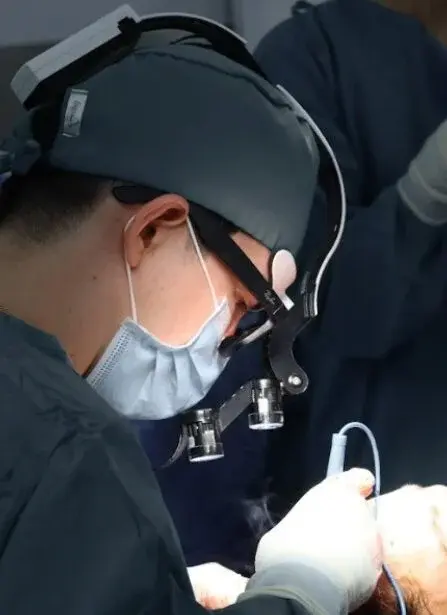
When patients first hear about hairline advancement surgery, they often imagine that the surgeon simply removes a strip of forehead skin and moves the hairline down. The principle is more sophisticated than that. Before I decide how far a hairline can be advanced, I evaluate how the scalp moves, where the incision can be placed, the direction and density of the hair, and the anatomical structures that need to be protected throughout the operation.
Why scalp laxity can determine how much the hairline can safely advance
One of the first things I assess is scalp laxity, or how freely the hair-bearing scalp can move over the tissues underneath it. This matters because every scalp behaves differently. Two patients may have a similar forehead height but very different surgical possibilities.
A scalp with good mobility may allow greater advancement. A tighter scalp may limit how far the hairline can be moved without creating excessive tension at the closure. That is why I do not plan forehead lowering surgery around a predetermined number of centimeters. I plan around what the patient's tissues can safely accommodate.
The amount of forehead reduction is determined by anatomy, not by a standard measurement.
Several factors influence this assessment:
Where is the incision made during forehead lowering surgery?
The forehead reduction surgery incision is typically planned at or immediately along the frontal hairline. Its exact shape is important. A natural hairline is not a perfectly straight line, so I consider the patient's existing contours, temporal areas, hair direction and density when planning where the incision will sit.
The goal is not only to reach the deeper tissues required for advancement. I am also thinking about how the incision will relate to the hairline once it has healed.
| What I evaluate | Why it matters |
|---|---|
| Existing hairline shape | Helps preserve a natural contour. |
| Hair density | Influences camouflage of the incision. |
| Hair direction | Affects incision planning and healing appearance. |
| Scalp mobility | Determines how much advancement may be possible. |
| Previous scars | May affect tissue movement and closure. |
This is one reason forehead reduction surgery needs individualized planning rather than using the same incision design for every patient.
What happens to the skin between the hairline and the forehead?
The easiest way to understand the surgical concept is to follow the sequence step by step.
The new hairline is planned
Before surgery, I mark the intended position according to the patient's facial proportions and scalp mobility.
The incision is created
The incision follows the surgical design at the frontal hairline.
The scalp is carefully mobilized
The hair-bearing scalp is released enough to allow controlled forward movement.
The planned segment is removed
The amount of forehead tissue removed corresponds to the advancement that can be achieved safely.
The hairline is advanced
The scalp is brought forward toward its newly planned position.
The incision is closed
The tissues are carefully approximated while managing tension and preserving the intended hairline shape.
What Happens After Forehead Reduction Surgery? Recovery, Scars, Risks and Results
One of the most common questions I receive after explaining the operation is: “What will I actually look and feel like afterward?” Recovery after forehead reduction surgery is about swelling. The scalp has been mobilized, a new hairline position has been created, and the incision needs time to mature. Understanding that process beforehand usually makes recovery much easier to interpret.
When can you wash your hair, return to work and resume exercise?
Recovery is better understood as a progression rather than a single date. Each patient heals differently, so these stages should be considered general references rather than fixed deadlines.
Swelling, tightness, incision care and rest are the main priorities.
Swelling and discomfort generally begin to improve progressively.
Patients gradually return to normal daily activities, depending on how healing is progressing.
Exercise can progressively resume once the patient has been medically cleared.
Scar maturation, sensory recovery and refinement of the final result continue.
Instructions depend on how the incision is healing. I explain when and how to wash the scalp while avoiding unnecessary friction.
Someone working from home may return sooner than a patient whose job involves physical exertion or significant public interaction.
Physical activity is resumed gradually. Activities that increase blood pressure or place tension on the surgical area require more caution during early healing.
Why Consider Dr. David Delgado for Forehead Reduction Surgery in Medellín?
If you are considering forehead reduction surgery, the goal should not be simply to lower the hairline by a certain number of centimeters. In my practice, I evaluate your facial proportions, hairline, scalp mobility, hair density, and expectations to determine whether hairline advancement surgery is appropriate and how to create a result that looks natural for your face.
I see patients at Torre Médica Oviedo in Medellín, Colombia, including international patients who can begin part of the evaluation before traveling. If you want to know whether forehead surgery reduction may be right for you, schedule a personalized evaluation with me, Dr. David Delgado, in Medellín.
Frequently Asked Questions About Forehead Surgery Reduction
1. What is forehead surgery reduction?
Forehead surgery reduction usually refers to forehead reduction surgery, a procedure designed to reduce the visible height of the forehead by advancing the hairline forward. It is also known as forehead lowering surgery, hairline lowering surgery, or hairline advancement surgery. The procedure does not simply remove skin; it involves careful planning of the hairline, scalp mobility, and facial proportions before the scalp is advanced into a new position.
2. Is forehead reduction surgery the same as a brow lift?
No. They are different procedures with different goals. A brow lift is intended primarily to reposition low or descended eyebrows and upper-forehead tissues. Forehead reduction surgery changes the position of the hairline itself. If the main concern is a high hairline, forehead reduction may be more relevant; if the concern is brow descent, a brow lift may be more appropriate.
3. How do I know if I am a good candidate for forehead reduction surgery?
A good candidate often has a naturally high but stable hairline, adequate scalp mobility, appropriate frontal hair density, realistic expectations, and good general health for elective surgery. During evaluation, I also look for signs of progressive hair loss, previous scars, scalp characteristics, and the relationship between the forehead, eyebrows, and the rest of the face.
4. How much can the hairline be lowered?
There is no universal number that applies to every patient. The amount of advancement depends on factors such as scalp laxity, tissue elasticity, hairline shape, previous procedures, and how much tension can be safely managed during closure. Two people with similar forehead heights may have very different possibilities, which is why this must be determined during a personalized surgical assessment.
5. Does forehead reduction surgery leave a scar?
Yes. Any surgical incision leaves a scar. In this procedure, the incision is generally placed along the frontal hairline so it can blend as naturally as possible with the surrounding hair. The scar is usually more noticeable during the early stages of healing and gradually matures over time. Its final appearance depends on incision design, genetics, hair density, tension, sun exposure, and individual healing.
6. Can hair grow through the forehead reduction scar?
Hair may help camouflage the scar depending on the incision technique, follicle direction, hair density, and healing process. However, I do not promise that hair will grow through every part of the incision or that the scar will become completely invisible. This is one reason why hairline design and follicle preservation are important parts of surgical planning.
7. How long does recovery after hairline advancement surgery take?
Recovery happens gradually. Swelling, tightness, bruising, and temporary numbness are common during the first days. Many patients progressively return to normal daily activities over the following weeks, while more strenuous exercise usually requires additional healing time and medical clearance. Scar maturation and sensory changes may continue improving for several months.
8. Can forehead reduction surgery cause hair loss?
Temporary shedding around the incision can occur after hairline lowering surgery because the follicles may be affected by surgical manipulation or temporary stress. The likelihood and degree vary from patient to patient. I also evaluate the possibility of underlying progressive hair loss before recommending surgery, because forehead reduction does not prevent genetically determined future recession.
9. Is forehead reduction surgery permanent?
The surgical repositioning of the hair-bearing scalp is intended to create a long-lasting structural change. However, the procedure does not stop aging or future changes in hair density. The hairline can still be affected by genetics, hormones, medical conditions, or progressive hair loss later in life, which is why long-term hairline stability is an important part of patient selection.
10. Is forehead reduction surgery better than a hair transplant for lowering the hairline?
Neither option is automatically better. They work in different ways. Hairline advancement surgery moves the existing hair-bearing scalp forward, while a hair transplant places follicular units into selected areas to create or reshape the hairline. The most appropriate option depends on scalp mobility, hair density, hair-loss pattern, desired degree of change, scar considerations, and the patient’s long-term goals.
References
Medical Disclaimer
The information on this page is for educational purposes only and does not constitute medical advice. Plastic surgery procedures carry inherent risks and individual results vary. Schedule a private consultation with Dr. David Delgado to evaluate your specific case, candidacy, and expected outcomes. This content reflects the surgeon's professional perspective and should not replace in-person medical evaluation.