Author
Dr. David Delgado, MD
Maxillofacial and plastic surgeon trained at Universidad Industrial de Santander and Universidad de Antioquia. Member of the American Society of Plastic Surgeons (ASPS), with over fifteen years of clinical practice in Medellín, Colombia.
- ASPS — Member
- SCCP
- UdeA Postgraduate Professor
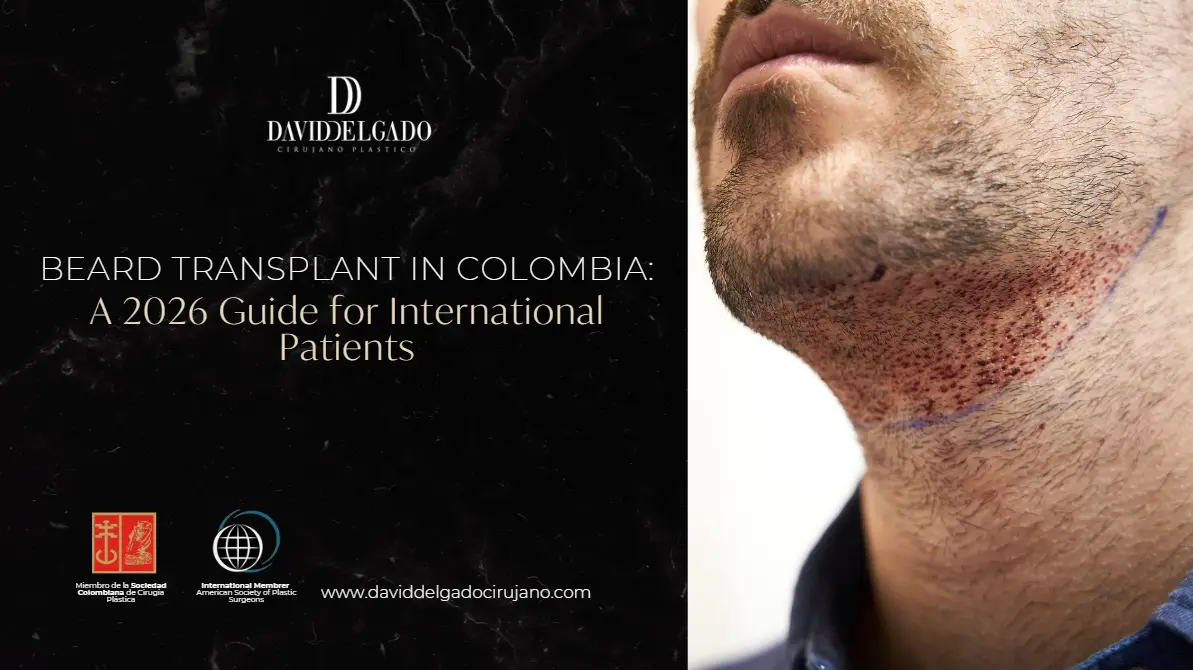
A patchy beard can affect more than your appearance—it can change the way you see your facial proportions, your profile, and even your confidence. For men with uneven growth, visible gaps, low density, or scars where facial hair no longer grows, a beard transplant in Colombia may offer a personalized way to restore coverage using your own follicles. These follicles are typically taken from a donor area on the scalp and carefully placed into the beard, mustache, sideburns, or other specific areas of the face to create a fuller and more balanced result.
At Clínica Be Dharma in Medellín, this procedure is offered through Dharma Hair, our specialized hair restoration division. Although I do not personally perform beard transplants, I present this service as part of our clinic’s medical offering, while the evaluation, planning, and procedure itself are carried out by Dharma Hair’s medical hair restoration team. In this guide, I will explain who a good candidate may be, how the procedure works, why it is often more localized than a scalp hair transplant, what can influence the cost, what recovery usually looks like, and what international patients should plan before traveling to Medellín.
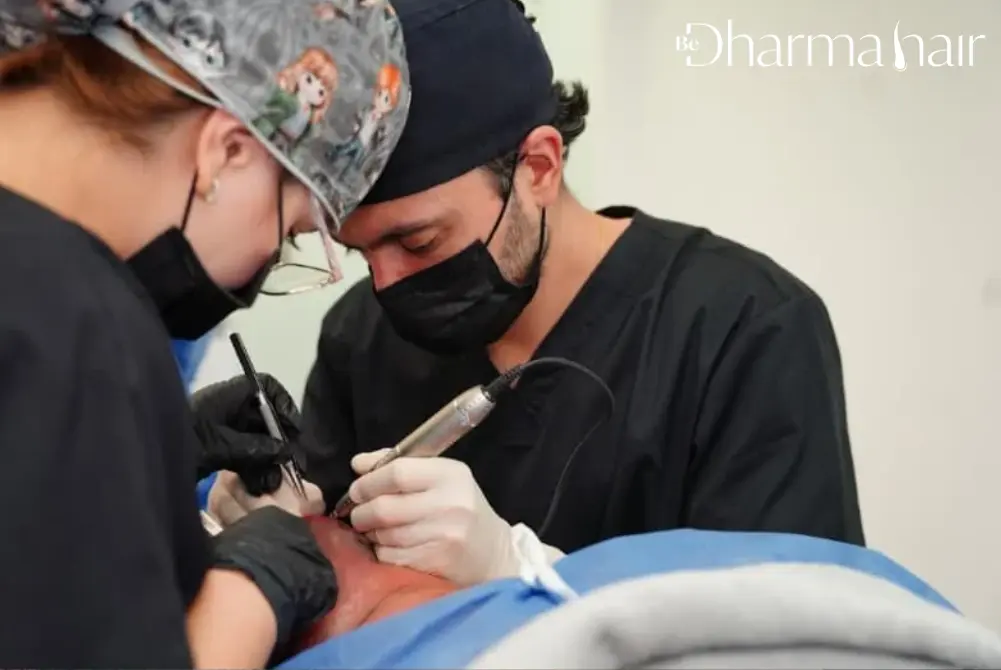
A Patchy Beard Does Not Have to Define Your Facial Appearance
Many men come to us after years of waiting for their beard to “fill in,” trying cosmetic products, or simply growing it longer in the hope that the empty areas will become less noticeable. In some cases, the beard does grow—but unevenly, with visible gaps that change the way the lower face looks. When those areas remain unchanged over time, a beard transplant for patchy beard can be considered as part of a personalized facial hair restoration plan.
The goal is not to create the same beard for every patient. It is to improve density where it is needed, respect the natural pattern of the existing facial hair, and design a result that fits the shape of the face.
Your beard may grow, but not where you need It
Patchy growth does not always mean a complete absence of facial hair. Some patients have good density on the chin but little growth on the cheeks. Others can grow a mustache and jawline beard, but there is no natural connection between the two. We also see differences between the right and left sides of the face, limited sideburn growth, or areas where the beard appears much thinner than the surrounding hair.
A beard density transplant may help improve these specific areas by placing selected follicles where coverage is limited. The plan must consider not only how many follicles are needed, but also the direction, angle, spacing, and thickness of the existing beard.
| Common concern | Area that may be treated | Main planning goal |
|---|---|---|
| Empty cheek areas | Upper or lower cheeks | Improve coverage without creating an overly sharp outline |
| Weak beard–mustache connection | Corners of the mouth | Create a smoother transition between existing hair |
| Uneven sides | One or both sides of the face | Improve visual symmetry while preserving natural variation |
| Limited sideburn growth | Sideburns and upper jaw | Connect the scalp hair and facial hair more naturally |
| Low overall density | Beard line, chin, or jaw | Add fullness without overloading the skin with grafts |
Can a Beard Transplant Cover Scars or Areas Without Hair?
In selected cases, a beard transplant for scars may help reduce the visual contrast between a scar and the surrounding beard. Follicles can sometimes be placed within or around a scarred area to improve camouflage, but this requires careful evaluation.
Scar tissue does not behave exactly like healthy skin. Its thickness, flexibility, and blood supply may vary, which can influence how well it supports transplanted follicles. Before recommending treatment, the medical team must assess:
- The type and age of the scar.
- The condition and circulation of the tissue.
- Whether the skin can safely receive follicular units.
- The quality and availability of the donor area.
- The density that can realistically be achieved.
For this reason, patients considering a facial hair transplant Colombia procedure for scar coverage should understand that the treatment plan may be more conservative and that no medical team should promise identical growth in every scarred area.
Not Every Patient Needs a Full Beard Transplant
One of the advantages of facial hair transplantation is that the procedure can be focused. A patient may only want to improve the cheeks, define the chin, strengthen the mustache, rebuild the sideburns, or fill the small gaps between existing sections of the beard.
This targeted approach can make the procedure more precise and, in many cases, less extensive than a full beard reconstruction. However, the treatment should never be based only on filling empty spaces. Each area must be designed in relation to the rest of the face. A personalized plan may focus on:
- Cheek density.
- Beard-to-mustache connections.
- Chin and goatee coverage.
- Sideburn reconstruction.
- Jawline definition.
- Small scarred or hairless areas.
At Dharma Hair, the objective is not to give every patient a larger beard. It is to determine which areas would benefit from treatment and how transplanted follicles can be integrated with the facial hair the patient already has.
Is a Beard Transplant Easier Than a Hair Transplant?
Patients often assume that a beard transplant is automatically easier than a scalp hair transplant. In many cases, it is a more localized procedure because the treatment may focus only on the cheeks, mustache, chin, sideburns, or a few visible gaps. That can mean fewer follicular units and a smaller recipient area than an extensive scalp restoration.
However, smaller does not always mean simpler. Facial hair grows at very specific angles, and even a limited treatment requires careful planning to avoid unnatural results. At Dharma Hair, the medical team evaluates not only how much hair is missing, but also how the transplanted follicles must blend with the facial hair that is already present.
A Smaller Treatment Area Can Mean a More Focused Procedure
A patient who wants to fill two small gaps in the cheeks will usually require a different procedure than someone seeking coverage across the cheeks, jawline, chin, and mustache. Compared with a large scalp transplant, a targeted beard procedure may involve fewer beard transplant grafts, less surface area, and a more focused design.
The complexity still depends on several individual factors:
| Planning factor | Why it matters |
|---|---|
| Area to be covered | Small gaps require a different plan than a full beard reconstruction. |
| Desired density | Greater density generally requires more available follicles. |
| Donor hair supply | The team must confirm that enough suitable follicles can be safely extracted. |
| Presence of scars | Scarred tissue may require a more conservative and technically demanding approach. |
| Chosen beard design | Sharp lines, mustache connections, and cheek coverage require different distributions. |
For this reason, I prefer to describe beard transplantation as a more localized procedure rather than simply calling it easier. The medical team must still balance density, donor availability, skin characteristics, and the patient’s expectations.
Facial Hair Must Follow Very Specific Angles and Directions
Natural facial hair does not grow in one uniform direction. On the cheeks, the hairs often lie close to the skin and angle downward. Around the mustache, the direction changes toward the lips. On the chin and jawline, the hairs may become more vertical or follow the contour of the lower face.
If follicles are placed too upright, too evenly, or in the wrong direction, the beard may look artificial even when the grafts grow successfully. The medical team must therefore reproduce the natural transitions between different areas of the face.
The design must account for:
- A low implantation angle close to the skin.
- Changes in direction across the cheeks, mustache, chin, and jaw.
- Irregular spacing resembles natural beard growth.
- The direction of the patient’s existing facial hair.
- A density that the skin and donor area can realistically support.
This is one of the reasons why facial design and follicle placement are just as important as the number of grafts used.
Where Does the Transplanted Beard Hair Come From?
In most cases, the follicles are obtained from a donor area on the back or sides of the scalp. These areas are commonly selected because they may contain follicles with stable growth characteristics and enough density to allow individual extraction.
During a hair transplant from scalp to beard, the team selects follicles that are suitable for the facial design. Single-hair follicular units are often especially valuable for creating softer borders and natural transitions, while other units may be used in areas where greater density is needed.
A FUE beard transplant Colombia procedure involves extracting follicular units one by one rather than removing a strip of scalp. At Dharma Hair, the suitability of a FUE beard transplant Medellin plan depends on the patient’s donor density, hair thickness, facial hair characteristics, and the number of areas that need treatment.
Important:
Transplanted scalp hair keeps many of the characteristics of its donor area. It can grow longer than native beard hair and may require regular trimming as it matures.
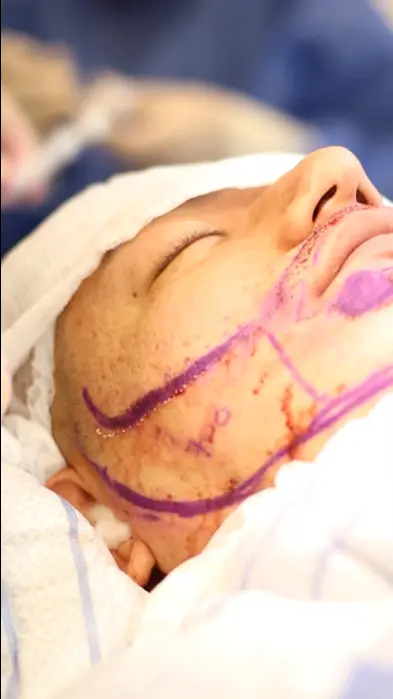
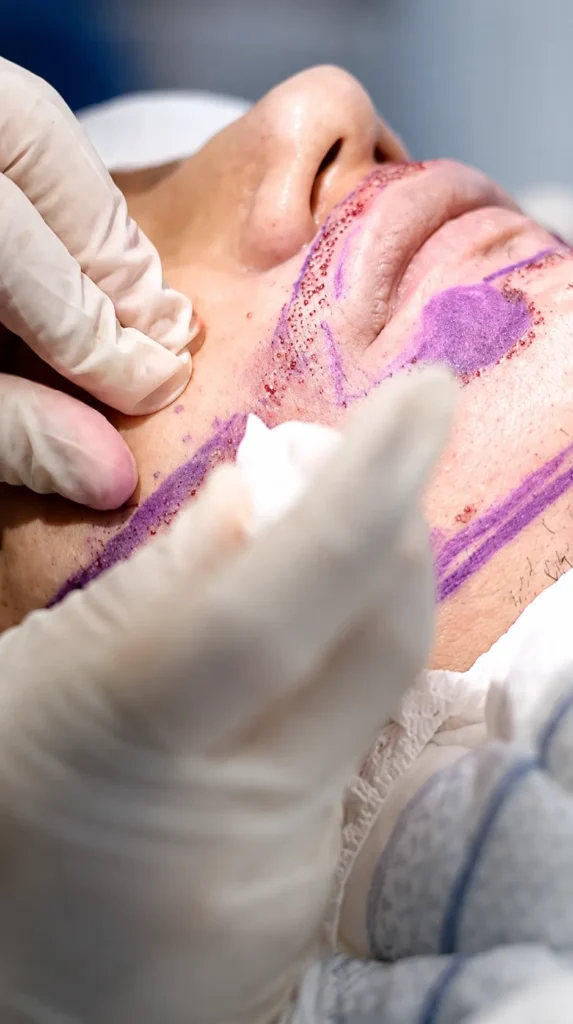
What Actually Happens During a Beard Transplant in Medellín?
Many international patients understand the basic idea of moving hair from the scalp to the face, but they are less certain about what happens before and during the procedure. A successful beard transplant in Medellin begins well before the first follicle is extracted.
The process starts with a medical assessment and a facial design created around the patient’s anatomy, existing beard pattern, donor area, and expectations. The procedure is then performed by the medical hair restoration team at Dharma Hair; the specialized hair division of Clínica Be Dharma.
A beard transplant should not begin by asking how many follicles can be extracted. It should begin by defining what needs to be improved and whether the proposed beard will look natural on your face.
What the Team Evaluates First
- The proportions of the cheeks, jaw, chin, lips, and lower face.
- The patient’s existing facial hair pattern.
- The areas where growth is absent or visibly weaker.
- The shape and density the patient wants to achieve.
- The quality, thickness, and availability of the donor hair.
- The presence of scars or previous procedures.
- The patient’s expectations and long-term grooming preferences.
Why Photos Are a Reference—Not a Template
Patients often arrive with celebrity photos or images of other transplant results. These references can help explain a preference, but they should not be copied directly.
It is to create a pattern that works with your facial structure and the hair you already have.
How Does the FUE Beard Transplant Process Work?
The team identifies the section of the scalp from which the follicles will be extracted and prepares the area for safe access and precise selection.
Local anesthesia is applied to the donor and recipient areas to help keep the patient comfortable during extraction and implantation.
During a FUE beard transplant Colombia procedure, follicular units are removed individually using specialized instruments.
After extraction, the follicular units are reviewed and organized according to their characteristics and suitability for each beard area.
Tiny recipient sites are prepared in the beard area so the final angle, direction, depth, and distribution support a natural-looking result.
The selected follicles are placed according to the design, using softer borders and carefully distributed density.
How Many Grafts Will Your Beard Transplant Need?
There is no single number that applies to every patient. Filling two small cheek gaps is very different from creating broader coverage through the cheeks, jawline, chin, sideburns, and mustache.
- The size of the areas without hair.
- The density of the existing beard.
- Whether the objective is subtle improvement or fuller reconstruction.
- The thickness and texture of the donor hair.
- The number of follicular units that can be extracted safely.
- Whether scarred tissue is being treated.
- The patient’s preferred beard outline and style.
At Dharma Hair, we do not begin with a predetermined graft package. We begin with the patient’s anatomy and then determine the number of follicles that may be appropriate, safe, and realistic for the desired result.
How Much Should You Budget—and How Long Will You Need in Medellín?
For international patients, planning a beard transplant involves more than comparing procedure prices. You also need to understand what the estimate includes, how your donor area will be assessed, when the final treatment plan is confirmed, and how much time you should allow for evaluation and early follow-up in Medellín.
At Dharma Hair, we prefer to provide a proposal based on your actual anatomy rather than offering a standard graft package. The size of the area, the desired density and the quality of the available donor follicles can significantly change the scope of treatment.
Beard Transplant Cost in Colombia: Small-Area Plans Start at USD 3,000
At Dharma Hair, a procedure focused on a small area may start at USD 3,000. This may apply to selected patients who want to improve limited gaps, a weak beard–mustache connection or another localized area. It should not be interpreted as a fixed price for every beard transplant.
The final beard transplant cost in Colombia may vary according to:
- The number of follicular units required.
- The number of facial areas being treated.
- The complexity of the beard design.
- The quality and density of the donor area.
- The presence of scars or altered skin.
- Whether more than one session may be advisable.
Patients asking how much is a beard transplant in Colombia should therefore be cautious with prices published without an evaluation. FUE pricing commonly varies according to factors such as the projected graft range and the clinical plan, which is why a personalized assessment is necessary before confirming the total fee.
A personalized quotation should explain what is included in your beard transplant price Colombia, the estimated scope of treatment and whether the preliminary graft calculation could change after the in-person examination.
Starting price
Small, localized treatment areas may start at USD 3,000 at Dharma Hair. Your final beard transplant Medellin cost is confirmed only after the team reviews your facial growth pattern, donor hair and treatment goals.
What Will the First Days of Recovery Look Like?
During the first days, the transplanted area may show small crusts around the follicles, redness, sensitivity and mild facial swelling. These changes are generally part of the early healing period, although their intensity and duration can vary between patients. Published clinical guidance on beard transplantation describes temporary redness and slight swelling among the expected early findings.
You will need to protect the grafts while they stabilize. Avoid touching or scratching the beard area, and do not shave it until the Dharma Hair team confirms that it is safe. Washing, physical activity, sun exposure and skincare should also follow the instructions provided for your procedure.
Early recovery priorities
- Do not rub, scratch or remove the small crusts.
- Avoid shaving until medically authorized.
- Follow the prescribed cleansing instructions.
- Protect the treated area from direct trauma and unnecessary friction.
- Contact the team if you notice symptoms outside the expected recovery process.
When Will Your New Beard Begin to Grow?
The beard transplant recovery timeline is progressive. The hairs visible immediately after implantation are not the result, and patients should expect several phases before the beard begins to look fuller.
| General stage | What you may notice |
|---|---|
| First days | The implanted hairs remain visible while redness and small crusts gradually improve. |
| Following weeks | Some of the transplanted hairs may temporarily shed. |
| Following months | New growth begins gradually from the transplanted follicles. |
| Later maturation | The hairs gain length and the appearance of density continues to develop. |
Temporary shedding after transplantation can be alarming, but it does not automatically mean the follicle has been lost. FUE guidance explains that the transplanted hairs may shed before new growth becomes visible over the following months, with the fuller result taking considerably longer to develop.
Patients who ask when does a beard transplant start growing should understand that there is no identical date for everyone. The beard transplant growth timeline depends on individual healing, follicular growth cycles, graft handling and postoperative care.
For this reason, beard transplant before and after photographs should always be interpreted according to the month in which they were taken. Early images do not represent final beard transplant results, and density should not be judged only a few weeks after the procedure.
Why Trust Dharma Hair with Your Beard Transplant in Colombia?
At Clínica Be Dharma, beard transplantation is offered through Dharma Hair, our specialized hair restoration division located in Torre Médica Oviedo in Medellín. Although I do not personally perform the procedure, every patient is evaluated and treated by a medical team focused on follicular transplantation. The team examines the donor area, plans the follicle distribution and designs the beard according to the patient’s facial shape, age, existing growth pattern, donor-hair thickness and personal preferences. We understand that choosing a beard transplant in Colombia is a personal decision, which is why the goal is never to apply a standard beard template, but to create a result that feels natural and consistent with your own features.
For patients traveling for a beard transplant Medellin, the Dharma Hair team provides guidance before arrival, coordinates the in-person evaluation and procedure, and explains the recovery instructions clearly. You can begin by sending photographs and telling us which areas you would like to improve. This initial review for a beard transplant for international patients can help determine whether you may be a candidate, which donor area could be considered, how many grafts you may need, how long you should plan to remain in Medellín, and which factors will define the final cost.
Frequently Asked Questions About Beard Transplant in Colombia
1. How much does a beard transplant cost in Colombia?
At Dharma Hair, treatment for small, localized beard areas may start at USD 3,000. However, the final beard transplant cost in Colombia depends on the number of follicular units required, the areas being treated, the complexity of the design, the condition of the donor area and whether scarred tissue is involved. A personalized quotation can only be confirmed after the medical team evaluates your facial hair pattern, donor density and treatment goals.
2. Who performs the beard transplant at Clínica Be Dharma?
Beard transplantation is offered through Dharma Hair, the specialized hair restoration division of Clínica Be Dharma. Although I present the service as part of our clinic’s medical offering, I do not personally perform the procedure. The evaluation, beard design, follicular extraction, implantation and medical supervision are handled by Dharma Hair’s hair restoration team.
3. Is a beard transplant easier than a scalp hair transplant?
A beard transplant is often more localized than an extensive scalp procedure and may require fewer grafts when only small gaps or specific facial areas are treated. However, this does not mean it is always technically easier. Facial hair must be implanted at very low and changing angles, following the natural direction of growth across the cheeks, mustache, chin and jawline. Precise planning is essential to avoid an artificial appearance.
4. Where does the hair used for a beard transplant come from?
The follicles are usually obtained from the back or sides of the scalp, where the donor hair is assessed for density, thickness and suitability. During a hair transplant from scalp to beard, follicular units are extracted individually and selected according to the facial area in which they will be placed. Because transplanted scalp hair retains many donor characteristics, it may grow longer than native beard hair and require regular trimming.
5. How many grafts are needed for a beard transplant?
There is no standard graft number for every patient. Filling a small space between the mustache and beard requires a different number of beard transplant grafts than rebuilding the cheeks, jawline, chin and sideburns. When patients ask how many grafts are needed for a beard transplant, photographs can provide preliminary guidance, but the definitive estimate requires a direct examination of the face and donor area.
6. Can a beard transplant fill patchy areas or cover scars?
A beard transplant for patchy beard can be used to improve limited density, uneven sides, weak connections or areas where facial hair does not grow. A beard transplant for scars may also be considered in selected cases, but scar tissue must be evaluated carefully because its thickness and blood supply can affect follicular growth. Not every scar is equally suitable for transplantation, and realistic expectations are essential.
7. Are beard transplant results permanent?
Transplanted follicles can retain their ability to grow after they become established in the recipient area. However, no responsible clinic should guarantee an identical survival rate or final density for every patient. Long-term beard transplant results depend on donor-hair quality, graft handling, skin characteristics, healing and adherence to postoperative instructions.
8. What is recovery like after a beard transplant?
During the early beard transplant recovery period, patients may notice redness, small crusts, sensitivity and mild swelling. The grafts must not be rubbed, scratched or shaved until the medical team provides authorization. In the following weeks, some transplanted hairs may shed temporarily before new growth begins progressively. The complete beard transplant recovery timeline varies between patients.
9. When will the transplanted beard begin to grow?
Patients asking when does a beard transplant start growing should expect a gradual process rather than an immediate final result. The implanted hairs are visible during the first days, followed by a possible temporary shedding phase. New growth usually develops progressively over the following months, while length, texture and the appearance of density continue to mature later. For this reason, beard transplant before and after photographs should always be reviewed according to how many months have passed since the procedure.
10. How should international patients prepare for a beard transplant in Medellín?
Patients considering a beard transplant in Colombia for international patients can begin by contacting Dharma Hair, sending clear photographs and sharing relevant medical information. The team may provide initial virtual guidance to help with preliminary travel planning, but this does not replace the in-person medical evaluation. Once in Medellín, the donor area, facial skin and existing beard are examined before the final design, graft estimate, cost and procedure plan are confirmed. Dharma Hair is located in Torre Médica Oviedo and provides guidance through evaluation, treatment and early recovery.
References
- Dua K, Verma V, Dua A. Beard and Moustache Reconstruction. Indian Journal of Plastic Surgery. 2021;54(4):483–488. DOI: 10.1055/s-0041-1739248.
- International Society of Hair Restoration Surgery. FUE Hair Transplant: Benefits, Process and Recovery. Clinical patient guidance on FUE costs, postoperative crusting, temporary shedding and progressive growth.
Medical Disclaimer
The information on this page is for educational purposes only and does not constitute medical advice. Plastic surgery procedures carry inherent risks and individual results vary. Schedule a private consultation with Dr. David Delgado to evaluate your specific case, candidacy, and expected outcomes. This content reflects the surgeon's professional perspective and should not replace in-person medical evaluation.