Author
Dr. David Delgado, MD
Maxillofacial and plastic surgeon trained at Universidad Industrial de Santander and Universidad de Antioquia. Member of the American Society of Plastic Surgeons (ASPS), with over fifteen years of clinical practice in Medellín, Colombia.
- ASPS — Member
- SCCP
- UdeA Postgraduate Professor
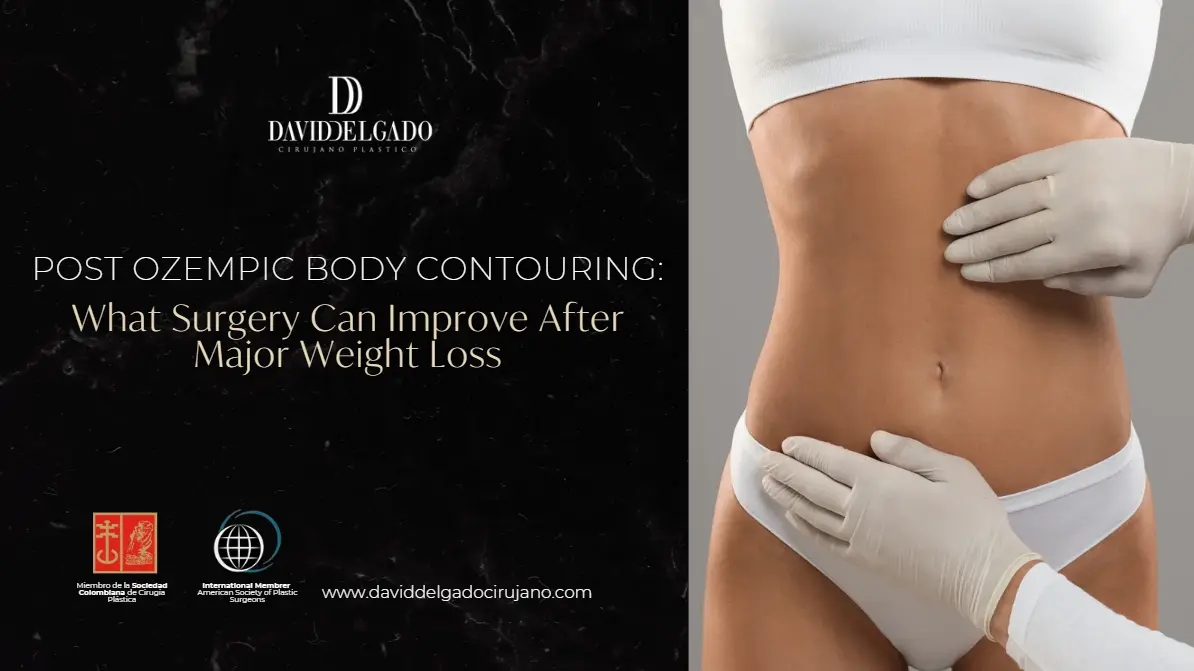
Losing a significant amount of weight can change your health, your clothing size, and the way you move through everyday life. Yet many of my patients tell me that, despite all that progress, they still do not feel comfortable with what they see in the mirror. The abdomen may still have hanging skin, the arms can look loose, the breasts may lose volume, and folds can remain around the waist or back. This is where post-Ozempic body contouring can become part of the next stage of your transformation.
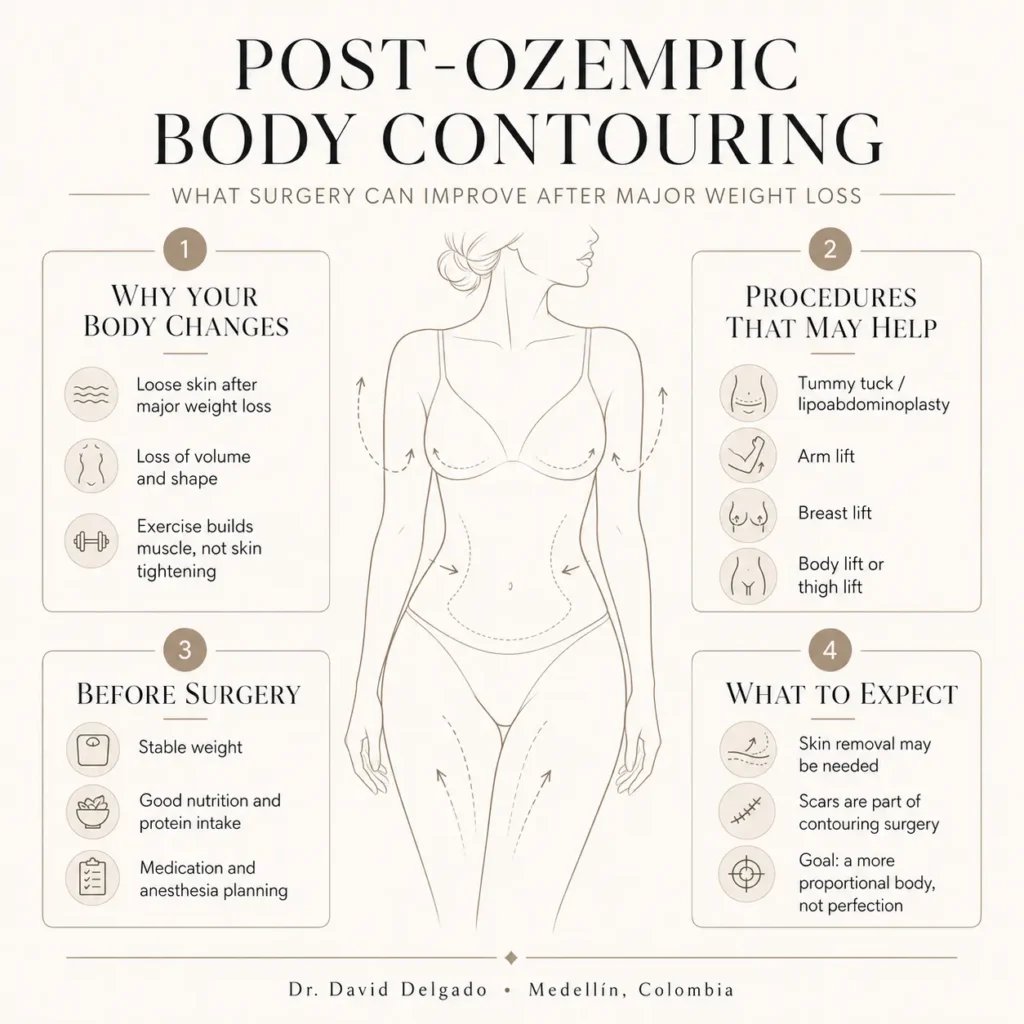
Weight loss reduces body volume, but it does not always allow the skin and underlying tissues to fully adapt to your new shape. Exercise can strengthen muscle and support weight maintenance, but it cannot remove significant loose skin after Ozempic or correct tissue that has stretched and descended. A post Ozempic body plan is not one standard surgery; it is a personalized approach that may combine different procedures based on the areas that concern you, the stability of your weight, your tissue quality, and your goals. The same principle applies to body contouring after GLP-1 weight loss: the right treatment begins with understanding what your body needs.
Why Does Your Body Still Have Loose Skin After Losing So Much Weight?
Reaching your goal weight does not always produce the body shape you imagined. You may feel healthier and wear a smaller size, yet still struggle with an abdominal fold, loose upper arms, flattened breasts or skin that gathers around your waist and thighs. In my experience, this can be especially frustrating because the remaining problem is no longer simply excess weight. It is the way the skin and supporting tissues responded to a major change in body volume.
Weight Loss Reduces Volume, but It Cannot Always Shrink Stretched Skin
Skin is flexible, but its ability to contract is not unlimited. When it has supported a larger body volume for months or years, its collagen, elastin and underlying tissues may not fully adapt after the fat beneath them decreases. This is why loose skin after major weight loss can remain even when a patient has reached a healthy or personally satisfying weight. The American Society of Plastic Surgeons explains that, following substantial weight loss, the skin and tissues may lack enough elasticity to conform to the body’s reduced size.
The amount of skin retraction varies from one person to another. During a consultation, I consider several factors:
- The amount of weight you lost.
- How quickly the weight came off.
- How long your skin remained stretched.
- Your age and natural skin quality.
- Genetic differences in tissue elasticity.
- Previous pregnancies.
- Major fluctuations in weight.
- Sun exposure, smoking history and general health.
Age, pregnancy, significant weight changes and genetic factors can all contribute to reduced tissue elasticity and sagging in areas such as the abdomen, buttocks and thighs. This is also why two people who lose the same number of pounds may end up with very different body contours.
My medical perspective:
Weight loss changes the size of the body, but it does not automatically restore the structure of skin that has been significantly stretched. The degree of excess skin—and where it appears—must be evaluated individually.
Why Exercise Cannot Remove Hanging Skin or Deep Body Folds
Exercise remains essential after weight loss. It helps preserve muscle, supports metabolic health and can improve the firmness of the tissues beneath the skin. However, exercise cannot cut away redundant skin or reposition tissue that has descended.
For example, abdominal training can strengthen the core, but it cannot remove an apron of skin hanging over the lower abdomen. Arm exercises may improve the shape of the biceps and triceps, but they cannot eliminate a large fold of skin between the armpit and elbow. Cleveland Clinic similarly notes that exercise tones the muscles but does not shrink significant excess skin in the upper arms.
The same principle applies to the breasts, thighs, buttocks and lower back. Once the main concern is excess skin rather than excess fat, losing more weight may not solve it—and in some patients, it can make the looseness appear more noticeable.
| What you do | What it can improve | What it usually cannot correct |
|---|---|---|
| Weight loss | Overall body volume, measurements and metabolic health | Skin that has lost significant elasticity |
| Strength training | Muscle tone, strength and body composition | An abdominal apron or hanging arm skin |
| Liposuction | Selected deposits of residual fat | Large amounts of loose or folded skin |
| Surgical body contouring | Excess skin, displaced tissues and selected areas of residual fat | Future weight changes or unrealistic expectations |
Surgical body contouring is not another method for losing weight. Its role is to remove excess skin and fat where appropriate and improve the shape of the tissues that remain after weight loss.
What Do People Mean When They Talk About an “Ozempic Body”?
The expression Ozempic body is an informal term, not a medical diagnosis. People generally use it to describe visible body changes after Ozempic, such as loose skin, reduced fullness, flatter buttocks, sagging tissues or changes in body proportions following rapid or substantial weight loss.
I do not use the term to suggest that Ozempic directly damages the skin. What usually matters is the magnitude and speed of weight loss, the amount of muscle and fat lost, and the patient’s pre-existing tissue quality. Medical sources have also clarified that changes popularly labeled with terms such as “Ozempic butt” are related to weight loss and body-composition changes rather than being unique to one medication.
These concerns can occur after:
- Ozempic or another semaglutide treatment.
- Other GLP-1 medications.
- Bariatric surgery.
- A medically supervised weight-loss program.
- Major changes in nutrition and physical activity.
For this reason, I evaluate an Ozempic body in the same careful way I assess any patient after significant weight loss. I look at the amount of excess skin, residual fat, muscle support, tissue position and overall proportions, not simply at which method helped the patient lose weight.
The goal is not to label the body. It is to understand why certain areas still feel disconnected from the progress you have achieved and determine whether a personalized body-contouring plan can address them.
You may be interested Before You Travel: How to Verify Your Plastic Surgeon in Colombia
Which Surgery Can Treat the Part of Your Body That Still Bothers You?
After major weight loss, patients rarely come to me with only one concern. Some feel uncomfortable because the lower abdomen folds over clothing; others avoid sleeveless shirts, feel their breasts look deflated or notice loose skin extending around the waist and back. I do not select a procedure based only on how much weight you lost or which medication you used. I evaluate where the skin is loose, where fat remains, how the tissues have descended and which changes matter most to you.
A Quick Guide to the Areas We Can Evaluate
| Your main concern | Procedure that may be considered | What it is designed to address |
|---|---|---|
| Hanging abdominal skin | Tummy tuck or lipoabdominoplasty | Excess skin, residual fat and abdominal contour |
| Loose upper arms | Arm lift or brachioplasty | Skin hanging between the armpit and elbow |
| Empty or low breasts | Breast lift, reduction or lift with implants | Position, skin excess, volume and proportion |
| Loose skin around the waist and back | Lower body lift | Circumferential skin excess and descended tissues |
| Loose inner thighs | Thigh lift | Skin folds, laxity and friction between the thighs |
When Your Abdomen Still Has Hanging Skin After the Weight Is Gone
The abdomen is often the area that causes the greatest frustration after weight loss. You may have lost inches from your waist but still see an apron of skin over the lower abdomen, folds around the navel or tissue that bunches inside fitted clothing. A tummy tuck after Ozempic may remove excess abdominal skin and improve the shape of the central abdomen. When residual fat also affects the waist or flanks, I may consider liposuction as part of a lipoabdominoplasty plan.
A tummy tuck after weight loss may also involve repairing separated or weakened abdominal muscles when this is clinically indicated. This decision is not made from an external photograph alone; it requires an examination of the abdominal wall, previous scars and the distribution of skin and fat. A lipoabdominoplasty after weight loss can combine skin removal with carefully planned fat reduction, but it is still a contouring procedure rather than a method for losing additional weight. Significant future weight changes can affect the result.
What I evaluate:
Is the main problem skin, fat, muscle separation—or a combination of all three? The answer determines whether liposuction, a tummy tuck or a combined approach is more appropriate.
When Loose Skin Makes You Hide Your Arms
Loose upper-arm skin can remain even when your arms are slimmer and stronger. Some patients tell me they avoid raising their arms, wearing sleeveless clothing or appearing in photographs because the skin moves independently from the muscle underneath. An arm lift after weight loss, also known as brachioplasty, removes a selected amount of excess skin and reshapes the upper arm.
An arm lift after Ozempic usually requires an incision along the inner or lower part of the arm. The exact position and length depend on how much skin needs to be removed and whether the laxity is limited to the upper arm or extends toward the armpit and chest. In a brachioplasty after weight loss, a shorter scar can only correct a limited area; more extensive loose skin generally requires a longer incision. I discuss that trade-off clearly because meaningful skin removal cannot be performed without a scar.
When Weight Loss Leaves the Breasts Empty, Low or Disproportionate
Breast changes after weight loss involve more than a loss of cup size. As volume decreases, the skin envelope may remain stretched, the nipple can sit lower, and the upper part of the breast may look empty. Patients frequently describe these changes as deflated breasts after weight loss, especially when the breasts no longer feel proportionate to the waist or torso.
A breast lift after weight loss removes excess skin and repositions the existing breast tissue. However, a lift does not automatically restore all the volume that was lost. Depending on your anatomy and preferences, the surgical plan may include:
- A breast lift using your existing tissue.
- A breast lift with implants when additional fullness is desired.
- A breast reduction when the breasts remain heavy or uncomfortable.
- Internal reshaping and repositioning of the breast tissue.
A breast lift after Ozempic should not be planned around implant size alone. I first evaluate the quality of the skin, the remaining breast volume, the nipple position, chest width and the amount of support the tissues can provide. The goal is to create a breast shape that fits your new proportions rather than trying to recreate someone else’s result.
When Loose Skin Affects Your Waist, Back, Buttocks or Thighs
Sometimes the excess skin is not limited to the front of the abdomen. It may continue around the flanks, form folds across the lower back or contribute to a flattened and descended appearance of the buttocks. In these cases, a body lift after weight loss may provide a more complete correction than an isolated tummy tuck.
A lower body lift after Ozempic can address the abdomen, waist, hips, outer thighs and buttock region through an incision that extends around the body. It removes a circumferential band of loose tissue and lifts the areas below it. Because this is a more extensive procedure, candidacy, surgical time, scarring and recovery must be assessed carefully.
When the main concern is loose skin on the inner thighs, friction when walking or folds that make clothing uncomfortable, a thigh lift after weight loss may be considered. The incision pattern depends on whether the laxity is concentrated near the groin or extends farther down the leg. As with every part of post weight loss body contouring, the procedure should match the true location and extent of the problem—not simply the name of a popular surgery.
Ozempic Body Before and After: What Can Surgery Really Change?
When patients search for an Ozempic body before and after, they are often looking for reassurance that the loose skin, folds and loss of shape can be improved. Surgery can create meaningful changes, but the outcome depends on what is causing the concern. Excess fat, loose skin, stretched muscle and descended tissue require different solutions.
Skin Removal and Liposuction Solve Different Problems
Liposuction removes selected deposits of fat through small incisions. It can refine the waist, flanks, back or other areas when the skin still has enough elasticity to adapt. However, liposuction after Ozempic cannot remove a hanging abdominal apron, shorten loose arm skin or lift tissues that have significantly descended.
Skin-removal surgery does what liposuction cannot: it excises redundant tissue and closes the remaining skin in a firmer position. In some patients, both approaches are useful during the same operation. They complement each other, but they are not interchangeable. ASPS patient guidance similarly notes that liposuction is not an effective treatment for loose sagging skin and that patients with poor skin elasticity may require additional surgery to remove and tighten the excess.
| Treatment | Primarily addresses | Does not primarily address |
|---|---|---|
| Liposuction | Localized residual fat | Large amounts of hanging skin |
| Skin excision | Loose, folded or redundant skin | Overall weight loss |
| Combined surgery | Skin excess and selected fat deposits | Every possible body concern in one operation |
The difference between liposuction vs skin removal after weight loss is especially important when considering Lipo 360 after weight loss. Lipo 360 may improve fat distribution around the torso, but it cannot replace a tummy tuck or body lift when the skin itself is the dominant problem.
Your Before-and-After Result Depends on Where the Tissues Have Changed
Two patients can lose the same number of pounds and still need completely different surgical plans. One may retain good skin elasticity but have localized fat around the waist. Another may have very little remaining fat yet present extensive loose skin across the abdomen, arms, breasts and thighs.
During your assessment, I look beyond the total amount of weight lost. I evaluate:
- Where the excess skin begins and ends.
- How much residual fat remains beneath it.
- The thickness and quality of the tissues.
- The position of the breasts and buttocks.
- The condition of the abdominal wall.
- Scars from previous surgery.
- Differences between the two sides of the body.
- Your overall proportions and priorities.
This is why online photographs cannot determine your operation. They may help communicate what bothers you, but a medical evaluation is necessary to understand what lies beneath the skin and which combination of procedures could produce a safe, proportionate improvement.
A Better Contour Also Means Accepting Strategically Placed Scars
I speak openly about scars because they are part of every skin-removal procedure. Removing excess skin requires an incision long enough to release and excise that tissue. A very small incision cannot correct a large area of looseness.
Whenever anatomy allows, I plan scars so they can be concealed beneath underwear, swimwear or the natural folds of the body. However, the final position and length depend on how much skin must be removed, where the laxity is located and how the tissues need to be lifted. Body-contouring guidance from ASPS notes that visible scars are a trade-off patients must accept to achieve a contour that better matches their new weight and proportions.
An honest way to think about the decision:
The question is not whether surgery leaves a scar. It is whether the expected improvement in shape, comfort and clothing fit is worth that scar to you.
How Do You Know Whether Your Body Is Ready for Surgery After Ozempic?
Reaching a lower number on the scale is an important milestone, but it does not automatically mean that your body is ready for surgery. Before recommending an operation, I need to know that your weight pattern, nutritional status, medical conditions and medication plan allow us to proceed as safely as possible.
01 Your Weight Should Be Stable Your contour should no longer be changing significantly.
If you are still losing weight quickly, the shape I evaluate during your consultation may continue to change. Additional weight loss after surgery can create new looseness, while significant weight gain can stretch the tissues and compromise the contour we created.
I generally want to see that your weight has stabilized and that you can maintain it through sustainable habits. There is no single waiting period for every patient. The timeline depends on how you lost weight, whether your medication dose is still changing, whether you underwent bariatric surgery and whether your health and nutrition have stabilized.
02 Nutrition Matters More Than Many Patients Expect Being lighter does not always mean being ready to heal.
Major or rapid weight loss can reduce body fat, muscle mass and nutritional reserves. Before an extensive procedure, I need to understand whether you are eating adequately, consuming enough protein and showing signs of anemia or other deficiencies that could affect healing.
This is especially important after bariatric surgery, prolonged calorie restriction or periods of nausea and poor intake while using weight-loss medication. Preoperative testing and, when needed, nutritional evaluation allow us to identify problems that should be corrected before surgery.
03 How Long Does Ozempic Stay in the Body? Your surgeon and anesthesiologist need a complete medication history.
Patients frequently ask, how long does Ozempic stay in the body? Semaglutide has an elimination half-life of approximately one week and may remain in circulation for about five weeks after the last dose. It can also delay gastric emptying, which is relevant when planning anesthesia.
This does not mean that every patient must automatically stop the medication five weeks before surgery. Factors such as recent dose increases, nausea, vomiting, bloating, constipation, medication dose and other conditions that affect gastric emptying must be reviewed by the clinical team.
04 Not Every Procedure Belongs in One Surgery A staged plan may offer a safer and more manageable recovery.
It is understandable to want to correct every area at once, especially when traveling for surgery. However, combining more procedures also increases operative time, recovery demands and the amount of tissue healing simultaneously.
Some combinations may be appropriate for a healthy, carefully selected patient. More extensive transformations may be safer and more predictable when divided into stages.
- Estimated duration of surgery
- Medical history and current health
- Number and size of treated areas
- Anesthetic and surgical risk
- Support available during recovery
- Required postoperative positions
- Safest order for treating each priority
A Practical Readiness Checklist
Before moving forward, I want to be able to answer “yes” to most of these points.
The right time for surgery is not simply when you have finished losing weight. It is when your body is stable enough to heal, your treatment plan is medically coordinated, and the expected benefits justify the procedure and recovery.
Why Trust Dr. David Delgado with Your Post-Ozempic Body Contouring Plan?
When you have already worked hard to lose weight, you deserve a surgical plan that looks at your body as a whole—not a preselected package or a recommendation made only from photographs. I evaluate which areas truly need skin removal, where liposuction may improve the contour, and whether certain procedures would be safer or more effective in a second stage. My experience includes tummy tuck and lipoabdominoplasty, Lipo 360, arm lift, breast lift and other breast procedures, body lift, thigh contouring, and facial or neck surgery when weight loss has also affected those areas.
I have more than 15 years of experience and am a member of the Colombian Society of Plastic, Aesthetic and Reconstructive Surgery and the American Society of Plastic Surgeons, credentials that international patients can verify before deciding. For patients considering body contouring in Medellin or body contouring in Colombia, my team provides guidance from the initial assessment through travel planning, surgery and early recovery. We are located at Torre Médica Oviedo in Medellín, where patients interested in Ozempic body contouring in Medellin can receive a personalized evaluation and coordinated support designed specifically for body contouring for international patients.
Frequently Asked Questions About Post-Ozempic Body Contouring
1. What is post-Ozempic body contouring?
Post-Ozempic body contouring is not one specific operation. It is a personalized surgical plan for treating excess skin, tissue laxity, changes in body proportions and selected areas of residual fat after significant weight loss. Depending on your anatomy, the plan may include a tummy tuck, arm lift, breast surgery, lower body lift, thigh lift or liposuction. Surgical body contouring is intended to improve the shape of the tissues that remain after weight loss; it is not another method for losing weight.
2. What changes can appear in an Ozempic body after major weight loss?
The term Ozempic body is commonly used to describe loose skin, reduced fullness and changes in proportion after substantial weight loss. You may notice hanging abdominal skin, loose upper arms, flattened breasts or buttocks, folds around the back, or laxity in the inner thighs. These changes are not exclusive to Ozempic. They can also occur after other GLP-1 medications, bariatric surgery or significant weight loss achieved through nutrition and exercise.
3. Can exercise tighten loose skin after Ozempic?
Exercise can strengthen your muscles, improve body composition and help you maintain your new weight, but it cannot remove a large amount of redundant skin. If the main concern is an abdominal apron, hanging arm skin or deep folds around the torso, additional training is unlikely to eliminate that tissue. In those cases, I evaluate whether skin-removal surgery may provide a more meaningful correction.
4. Do I need a tummy tuck after losing weight with Ozempic?
Not every patient needs a tummy tuck. I may consider a tummy tuck after Ozempic when excess abdominal skin remains, particularly if it folds over the lower abdomen or interferes with clothing and comfort. During the evaluation, I also determine whether residual fat, previous scars or separation of the abdominal muscles should be addressed. If loose skin extends around the waist and back, an isolated tummy tuck may not be the most complete option.
5. Can liposuction replace skin-removal surgery?
Liposuction and skin excision treat different problems. Liposuction removes localized fat, while skin-removal surgery excises tissue that has lost the ability to contract. Liposuction after Ozempic may help refine the waist, flanks or back when skin elasticity is adequate, but it cannot remove a hanging fold of skin. Some patients benefit from combining both techniques, although the decision depends on tissue quality, circulation and surgical safety.
6. How stable should my weight be before body-contouring surgery?
I want your weight to be stable enough that your body shape is no longer changing significantly. There is no single waiting period that applies to everyone. I consider how quickly you lost weight, whether your medication dose is still changing, whether you underwent bariatric surgery and whether your nutrition and general health have stabilized. Maintaining a stable weight is also important for preserving the result over time.
7. How long does Ozempic stay in the body before surgery?
Patients often ask, how long does Ozempic stay in the body? Semaglutide has an elimination half-life of approximately one week and may remain in circulation for about five weeks after the final dose. However, this does not mean every patient must discontinue it for five weeks. Current perioperative guidance recommends an individualized assessment based on symptoms, dose changes, the risk of delayed gastric emptying and the medical consequences of stopping treatment. Never suspend or restart the medication without coordinating with your prescribing physician, surgeon and anesthesiologist.
8. Can several post-weight-loss procedures be performed together?
Some procedures can be combined with carefully selected patients, but treating every area in one operation is not always advisable. I consider the estimated surgical time, your medical history, the number of areas involved, anesthetic risk and the demands of recovery. A staged plan may allow us to prioritize the areas that bother you most while avoiding an unnecessarily long or difficult operation.
9. How visible are the scars after post-weight-loss body contouring?
Skin-removal surgery always leaves scars because an incision is required to remove redundant tissue. I plan their position strategically and try to place them beneath underwear, swimwear or natural body folds when your anatomy allows. Their length depends on how much skin must be removed: extensive laxity generally requires a longer incision. Scars usually mature and become less noticeable over time, but they remain a permanent trade-off for achieving a smoother contour.
10. Can international patients travel to Medellín for post-Ozempic body contouring?
Yes, but the trip must be planned around medical care rather than treated like a short vacation. Before confirming surgery, I need to review your medical history, weight-loss process, medications, photographs and surgical priorities. Once you arrive in Medellín, an in-person examination is necessary to confirm the plan. You must also remain in the city long enough for surgery, early recovery and postoperative appointments before being cleared to travel. My team guides international patients through this process from our location at Torre Médica Oviedo.
Referencias
- American Society of Plastic Surgeons. (n.d.). Body contouring. American Society of Plastic Surgeons.
- American Society of Plastic Surgeons. (n.d.). Body contouring candidates. American Society of Plastic Surgeons.
- American Society of Plastic Surgeons. (n.d.). Tummy tuck. American Society of Plastic Surgeons.
- American Society of Plastic Surgeons. (n.d.). Arm lift. American Society of Plastic Surgeons.
- American Society of Plastic Surgeons. (n.d.). Breast lift. American Society of Plastic Surgeons.
- American Society of Plastic Surgeons. (n.d.). Body lift. American Society of Plastic Surgeons.
- U.S. Food and Drug Administration. (2025). Ozempic: Full prescribing information. FDA.
- American Society of Anesthesiologists. (2024). New multi-society GLP-1 clinical practice guidance released.
- American Society of Plastic Surgeons. (2023). Ozempic weight loss is affecting plastic surgery—here’s how.
Medical Disclaimer
The information on this page is for educational purposes only and does not constitute medical advice. Plastic surgery procedures carry inherent risks and individual results vary. Schedule a private consultation with Dr. David Delgado to evaluate your specific case, candidacy, and expected outcomes. This content reflects the surgeon's professional perspective and should not replace in-person medical evaluation.